You need accreditation from a federally recognized accreditor if you want your students to use federal Title IV aid, and you do not need it to be licensed by your state. NACCAS is one such accreditor, but its own federal recognition is under review. In July 2026, a federal advisory panel voted 9-to-3 to recommend that the Education Department deny NACCAS's renewal, and the final decision is still pending as of October 9, 2026.
So the better question is not "Do I need NACCAS?" but "Do I need federal aid, and which recognized accreditor will carry me?" This guide is for owners of existing beauty and barber schools and founders planning a new one. Cash-pay-only schools can skip to the section on what you can safely ignore.
State approval answers "Can this school operate and train for a license?" Accreditation answers "Has an outside body judged this school against national standards?" They are different systems with different owners.
In California, for example, cosmetology schools are approved to operate by the Bureau for Private Postsecondary Education (BPPE), and school catalogs also list course approval by the Board of Barbering and Cosmetology.
A California school's catalog can show a NACCAS accreditation next to those approvals, as an addition, not as the basis of its state authority. Your state board's rules decide whether your graduates can sit for the licensing exam, and accreditation does not substitute for them.
You need a recognized accreditor if students will pay with Pell Grants or federal loans. Federal rules define an eligible proprietary institution as one that, among other conditions, is accredited and has existed for at least two years.
NACCAS describes itself as recognized by the U.S. Department of Education as a national accrediting agency for cosmetology arts and sciences schools, which is why many beauty schools use it for that purpose.
You may not need it if your students pay cash or use private or employer funding, or if you are within your first two years and focused on state approval. You can operate, train, and graduate licensed professionals without it.
One caution applies to marketing. Accreditation is not a quality guarantee and is not required for licensure, so do not imply either in your advertising or enrollment conversations.
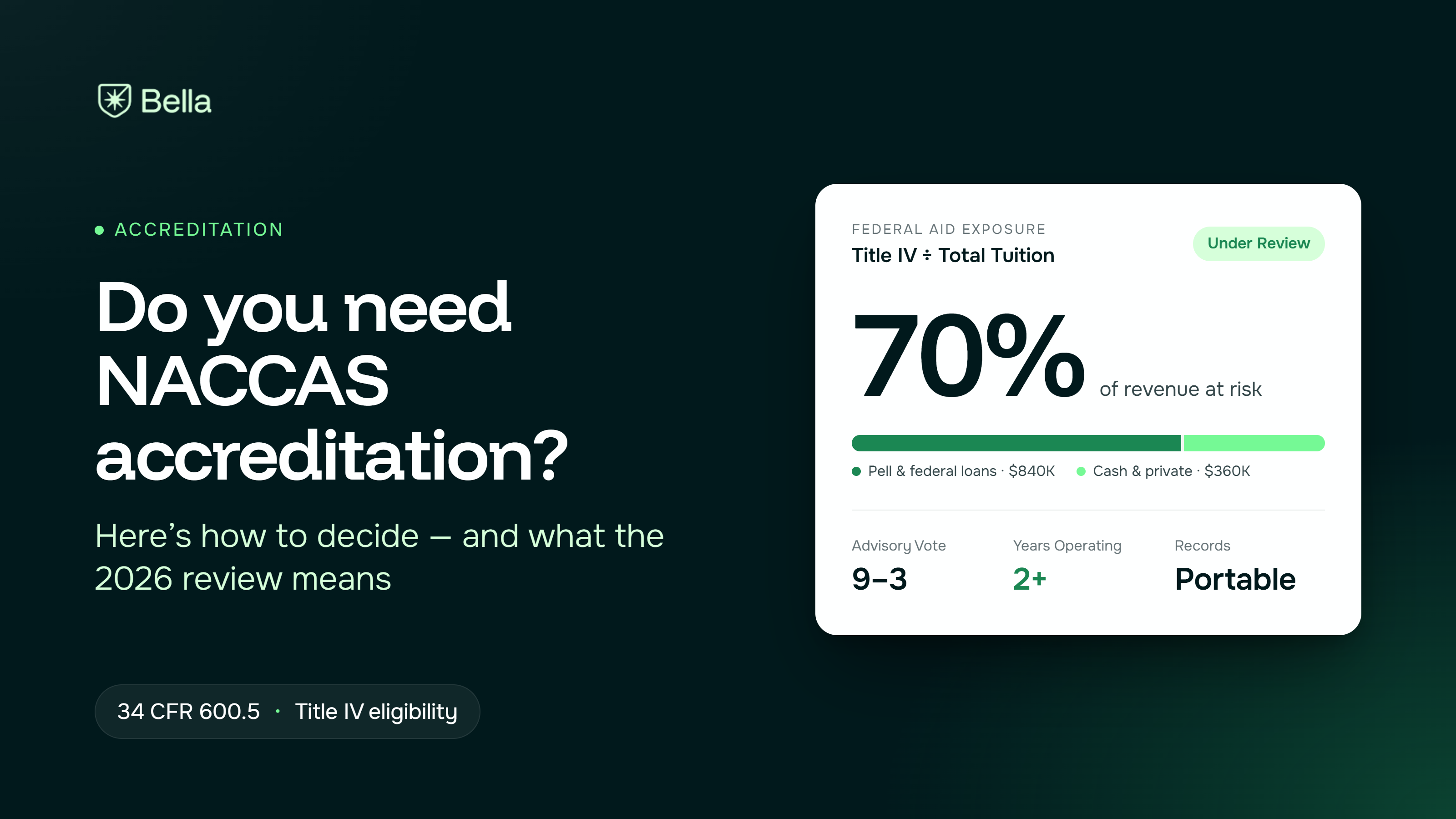
Run one calculation before you decide: Title IV revenue ÷ total tuition revenue.
Example: a school collects $1,200,000 a year in tuition, and $840,000 comes from Pell and federal loans. Exposure is 840,000 ÷ 1,200,000 = 70%. If the school lost its accreditor's recognition and could not replace it in time, up to 70% of revenue would be at risk. A school at 15% exposure faces a different decision than one at 70%.
Proprietary schools also face the 90/10 rule, which limits reliance on federal aid.
On July 22-23, 2026, the National Advisory Committee on Institutional Quality and Integrity (NACIQI) voted 9-to-3 to recommend that the Department of Education deny NACCAS's petition for renewed recognition, according to Inside Higher Ed.
Concerns cited included the number of programs on probation at once, weak disclosure of accreditation status to students, poor graduate earnings outcomes, high tuition and debt relative to earnings, and letting programs restart the compliance clock each time a new error is found.
The vote is advisory. Education Under Secretary Nicholas Kent makes the decision. Two outcomes were described: denial, after which NACCAS schools would need another accreditor or lose federal aid access, or the Department staff's original plan, under which NACCAS stays recognized but cannot take on new institutions.
NACCAS accredits more than 1,000 institutions per department data. NACCAS officials argued that earnings data used in the review does not capture all tip income, and a department official said adjusting for tips would not have a significant impact.
As of October 9, 2026, no final decision was found in the sources reviewed. Check the Department of Education's recognition pages before acting on any of this.
The process in sources reviewed has two stages. A school first obtains candidate status, then applies for initial accreditation. NACCAS's guidance describes candidate applicants as exempt from the two-year operating requirement, but the owner must attend a NACCAS workshop and the school's financial statements must be audited by an independent CPA.
NACCAS materials from 2017 estimated total fees of about $10,813 for a school that obtains candidate status and initial accreditation within a year, covering the application, a consultation visit, an evaluation visit, and the first annual fee.
They also describe initial accreditation as typically completed within 8 to 10 months of a complete application, and candidate status as lasting two years. These figures are several years old, so ask NACCAS for the current fee schedule and rules before budgeting.
Once accredited, NACCAS states that schools are re-evaluated at least once every six years.
Nothing changes today. NACCAS remains recognized while the Department decides. Use this period to prepare, in this order:
Your compliance routine matters here. Our beauty school compliance checklist lists the documents any accreditor will check, from annual reports to hour tracking.
Accreditation is a funding decision, not a licensing one. If your students rely on Title IV aid, you need a recognized accreditor, and today that question is less settled for NACCAS than it has been in decades.
Calculate your exposure, keep your records portable, and watch the Department's decision. Schools with clean, exportable hours and outcomes data can change accreditors without starting over.
If you want records that stay audit-ready whichever accreditor you use, book a Bella demo.
No. You need state approval to operate and train for licensure. Accreditation from a federally recognized accreditor is needed to participate in Title IV federal aid, and a proprietary school must also have existed for at least two years to qualify.
No. Accreditation by a recognized agency is a condition of an eligible proprietary institution under 34 CFR 600.5. A school with only state approval would not qualify for Title IV in the sources reviewed.
Yes, as of October 9, 2026, no final decision had been found. A July 2026 advisory vote recommended denying renewal, and the Under Secretary will decide. Verify current status on the Department's website.
NACCAS materials describe candidate status lasting two years and initial accreditation typically completed within 8 to 10 months of a complete application. These are older guidance figures, so confirm the current timeline with NACCAS.
Frequently asked questions ordered by popularity. Remember that if the visitor has not committed to the call to action, they may still have questions (doubts) that can be answered.
Not at all. We’ll move your data and guide your team. You’ll be ready to go in days, not weeks.
Yes. Bella is built for vocational schools and stays updated with state and federal rules.
Bella is made to be simple. If you can check email, you can use it. And we’re here to help whenever you need.
It helps spot missing info, flags risks early, and reminds you of what’s due—without you having to dig.
Yes. Pricing scales with your size, and most schools save time and money within the first month.
Absolutely. Bella uses encrypted, secure hosting and is fully FERPA compliant.
Tips, checklists, and insights for school owners and admins, written in plain language, not tech speak.