NACCAS accreditation is not optional if your school wants to access federal student aid, accept VA benefits, or operate with any credibility in the wider education ecosystem. But the process of getting and maintaining accreditation is complex. Schools often underestimate what it requires, move forward without proper planning, and then face surprise findings during accreditation reviews. Others have the accreditation but let compliance drift afterward. Both paths lead to the same outcome: accreditation at risk. This is the complete roadmap for schools seeking NACCAS accreditation and for schools that have it and need to stay compliant.
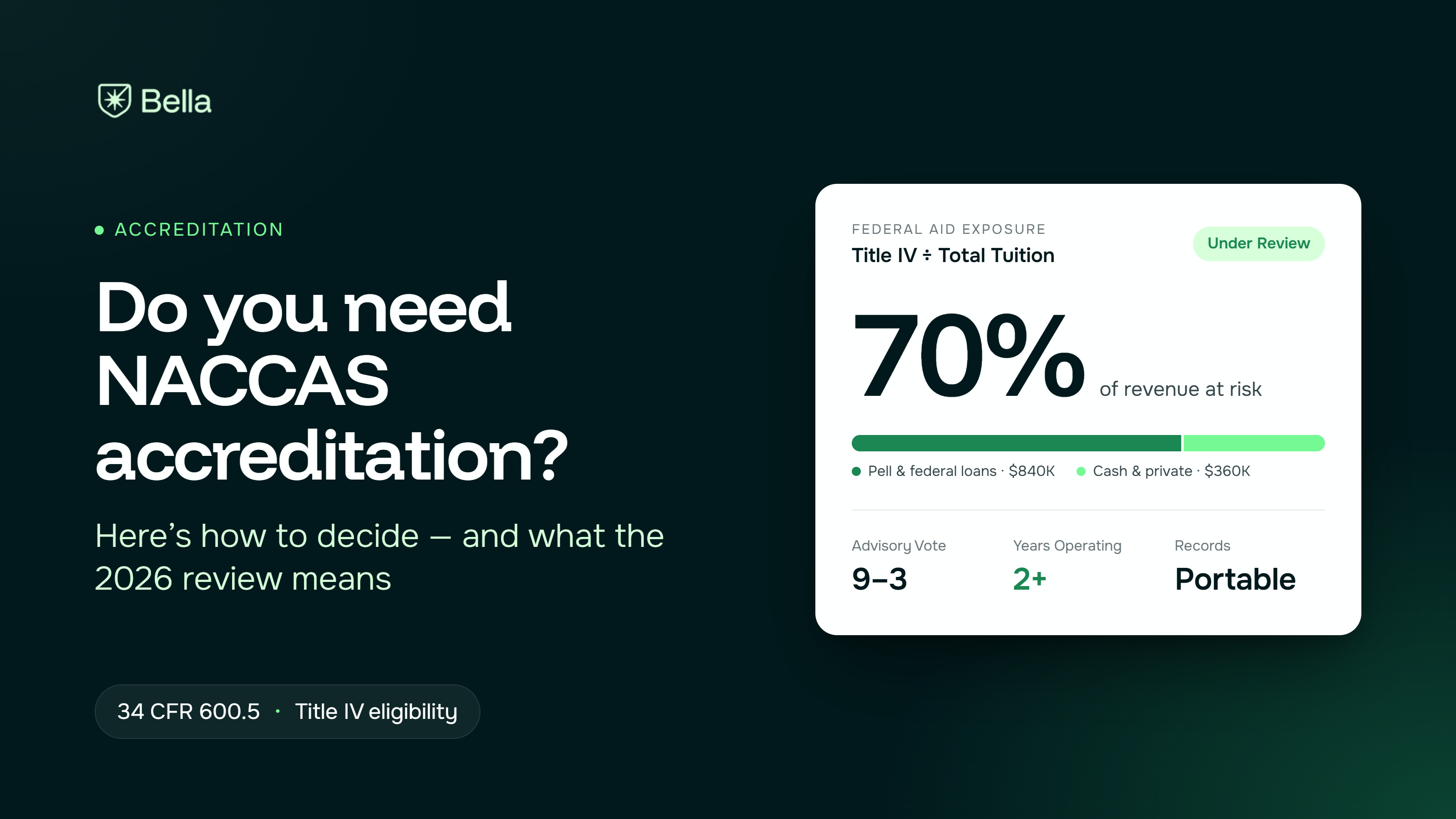
NACCAS (National Accrediting Commission of Career Arts and Sciences) accredits cosmetology, barbering, and esthetics schools across the United States. Its accreditation is recognized by the U.S. Department of Education. This means students at a NACCAS-accredited school can access federal student aid (Pell Grants, federal loans, Work-Study). Schools can enroll students using VA benefits (GI Bill, Vocational Rehabilitation, etc.). Employers recognize the credential as legitimate. Credit transfers are more likely between NACCAS schools. The accreditation provides external validation that your school meets a set of standards. For schools, accreditation opens funding doors. Without it, your student population is limited to cash-payers and those with private loans or employer sponsorship. For a cosmetology school relying on a mix of funding sources, that's a serious constraint. The cost of accreditation is the administrative burden and the fees NACCAS charges (around $5,000 for initial accreditation, then annual maintenance fees). The benefit is access to the entire federal student aid system and the students who depend on it.
The NACCAS accreditation process takes between 18 and 24 months from start to finish if you're coming in cold. It has distinct phases: Phase 1: Pre-accreditation (self-study and institutional research). You assemble evidence that your school meets accreditation standards. You develop policies, procedures, and documentation that align with NACCAS requirements. This phase takes 6-9 months. Phase 2: Application and review. You submit your accreditation application along with required documentation. NACCAS assigns an accreditation advisor who reviews your materials and identifies gaps. This phase takes 3-4 months. Phase 3: On-site evaluation. An accreditation team visits your school to verify that what you documented actually exists and is actually happening. This is the moment of truth. This phase takes 1-2 months. Phase 4: Accreditation decision and initial approval. NACCAS reviews the evaluation team's findings and issues an accreditation decision. Most schools either receive accreditation or receive accreditation with recommendations. Some receive probationary accreditation. This phase takes 1-2 months. Phase 5: Post-accreditation compliance and renewal. Once accredited, you maintain compliance through annual self-reports and triennial (every three years) re-accreditation reviews. The maintenance phase is continuous.
The pre-accreditation phase is where most schools either succeed or hit a wall. NACCAS publishes its standards, and schools need to demonstrate compliance across a set of institutional requirements: Institutional Effectiveness and Planning. Schools must have a clear mission statement, institutional goals, and a process for evaluating whether goals are being met. Educational Quality. Programs must have clearly defined student learning outcomes, curriculum that supports those outcomes, and assessment data showing whether students are actually learning. Student Support Services. Schools must have processes for admissions, advising, financial aid, and student complaints. Financial Stability. Schools must demonstrate that they have sustainable funding and financial management practices. Facility and Equipment Standards. Your classroom, clinic, and equipment must meet NACCAS specifications. Faculty Qualifications. Instructors must meet specific education and licensing requirements. Compliance with all applicable laws. This is the catch-all category that includes state regulations, federal financial aid rules, and consumer protection laws. The most common stumbling blocks: Schools don't have documented student learning outcomes. They know their students learn to cut hair, but they haven't written down the specific competencies students should demonstrate. Schools don't have assessment data. Even if outcomes are written, schools often don't have systematic data showing whether students are actually meeting them. Schools don't have financial documentation. Owners often run schools without clear accounting, P&L statements, or financial plans. Schools don't have institutional policies. HR policies, student complaint procedures, refund policies, and student code of conduct are informal or missing entirely. Schools don't have consistent compliance records. Documentation is scattered, incomplete, or nonexistent.
If you're pursuing NACCAS accreditation, build this foundation now. Develop student learning outcomes for each program. Work with your instructors to define what graduates should be able to do. Write it down. Document that outcomes. Have students demonstrate competency, and keep records. You'll need this data for the accreditation review. Create an institutional self-study. Use the NACCAS standards as your checklist. Write out how your school meets each standard. This becomes your formal self-study document. Hire an accreditation consultant if you're not experienced with this. Many schools do this work themselves and waste 6+ months on a poor-quality self-study that NACCAS rejects. A consultant costs $2,000-5,000 but saves time and iterations. Assemble all required documentation. Personnel files with credentials, program curricula, admission policies, refund policies, student grievance procedures, financial statements. Get organized. Implement a student information system that tracks enrollment, attendance, grades, and outcomes. NACCAS will ask to see this data. If it's scattered across paper and spreadsheets, you'll struggle. A cloud-based system like Bella that's designed for beauty schools captures everything in one place and generates the reports NACCAS requires. Conduct an internal audit against NACCAS standards. Before you submit to NACCAS, do a complete self-audit. Find gaps. Fix them. The on-site evaluation team will find everything eventually; it's better to find and address issues yourself first.
The on-site visit typically lasts 2-3 days. An accreditation team (usually 2-3 experienced educators from other schools) visits your campus. They review student files, observe classes, interview students and staff, tour facilities, and verify that your documentation matches reality. This is not a surprise inspection, but it is rigorous. Common findings during evaluations: Student files are incomplete or missing required documents. Student learning outcomes data is not actually being collected. Facilities don't meet standards (lighting, ventilation, equipment condition). Faculty credentials are not properly documented. Financial records are incomplete or inaccurate. The team produces a report with findings. If findings are minor, you receive accreditation with recommendations. If findings are significant, you receive probationary accreditation and have 18-24 months to address issues. If findings are severe, accreditation is denied, and you can reapply in a year.
Once you're accredited, the work doesn't stop. NACCAS requires annual self-reports and a full re-accreditation evaluation every three years. Many schools let compliance drift after accreditation is granted, thinking they're done. That's when citations start piling up. To maintain accreditation: Keep student records current and complete. Continue assessing student learning outcomes. Maintain financial documentation. Update institutional policies as regulations change. Submit annual reports on time. Prepare thoroughly for triennial reviews. The re-accreditation process is lighter than initial accreditation, but it still requires documentation and often results in an on-site visit. Schools that maintain accreditation are the ones that treat it as an ongoing system, not a one-time achievement.
Initial NACCAS accreditation: 18-24 months, $5,000 application fee, $2,000-5,000 for consultant support (if used), staff time to gather documentation and prepare self-study. Annual maintenance and fees: $1,500-2,500 per year, ongoing staff time for annual reports. Triennial re-accreditation: $3,000-5,000 (varies), 2-3 months of preparation time, on-site evaluation (covered by NACCAS).
NACCAS accreditation is achievable for any school committed to building compliant systems. The bottleneck is not the accreditation body; it's the school's readiness. Schools that struggle are the ones trying to obtain accreditation without first fixing their operations. Schools that succeed have documented processes, complete records, and systems in place before they apply. If you're considering accreditation, start by getting your house in order. Implement a student information system. Document everything. Get institutional policies in writing. Then pursue accreditation. You'll move through the process faster and with fewer findings. If you're already accredited, remember that accreditation is maintained or lost by the systems you keep current. Don't let compliance drift.
Frequently asked questions ordered by popularity. Remember that if the visitor has not committed to the call to action, they may still have questions (doubts) that can be answered.
Not at all. We’ll move your data and guide your team. You’ll be ready to go in days, not weeks.
Yes. Bella is built for vocational schools and stays updated with state and federal rules.
Bella is made to be simple. If you can check email, you can use it. And we’re here to help whenever you need.
It helps spot missing info, flags risks early, and reminds you of what’s due—without you having to dig.
Yes. Pricing scales with your size, and most schools save time and money within the first month.
Absolutely. Bella uses encrypted, secure hosting and is fully FERPA compliant.
Tips, checklists, and insights for school owners and admins, written in plain language, not tech speak.