BPPE inspectors do not show up with a vague mandate to look around. They arrive with a specific list of records they need to review, and they expect those records to be produced immediately. The schools that pass inspections without citations are not the ones with perfect operations. They are the ones who can locate, organize, and hand over their documentation while the inspector is still in the building. This is the checklist. Not the regulatory framework or the philosophy behind it. The actual list of what inspectors will request, what your files need to contain, and how to organize your school so that any authorized staff member can respond.
What Inspectors Request First: Student Files The inspection starts with student files. Inspectors will ask for a sample, typically five to ten records pulled from three categories: currently enrolled students, withdrawn students, and graduates. You do not get to choose which files. The inspector selects the names. Each student file must contain the following documents. Treat this as a literal checklist. If any item is missing from any file, that file is deficient: Proof of high school completion or equivalency. This means a copy of the student's high school diploma, GED certificate, equivalency certificate, or ability-to-benefit test results. The document must be in the file at or before enrollment, not collected after the student starts class. Under 5 CCR §71920(b)(1)(A), this is one of the most frequently cited violations. In the second half of 2025, 13 schools were cited for this single issue, with some schools missing the document in every file reviewed. A fully executed enrollment agreement. The agreement must be signed by an authorized employee of the school and by the student. The student's signature must be dated before the enrollment start date. All required student initials under CEC §94912
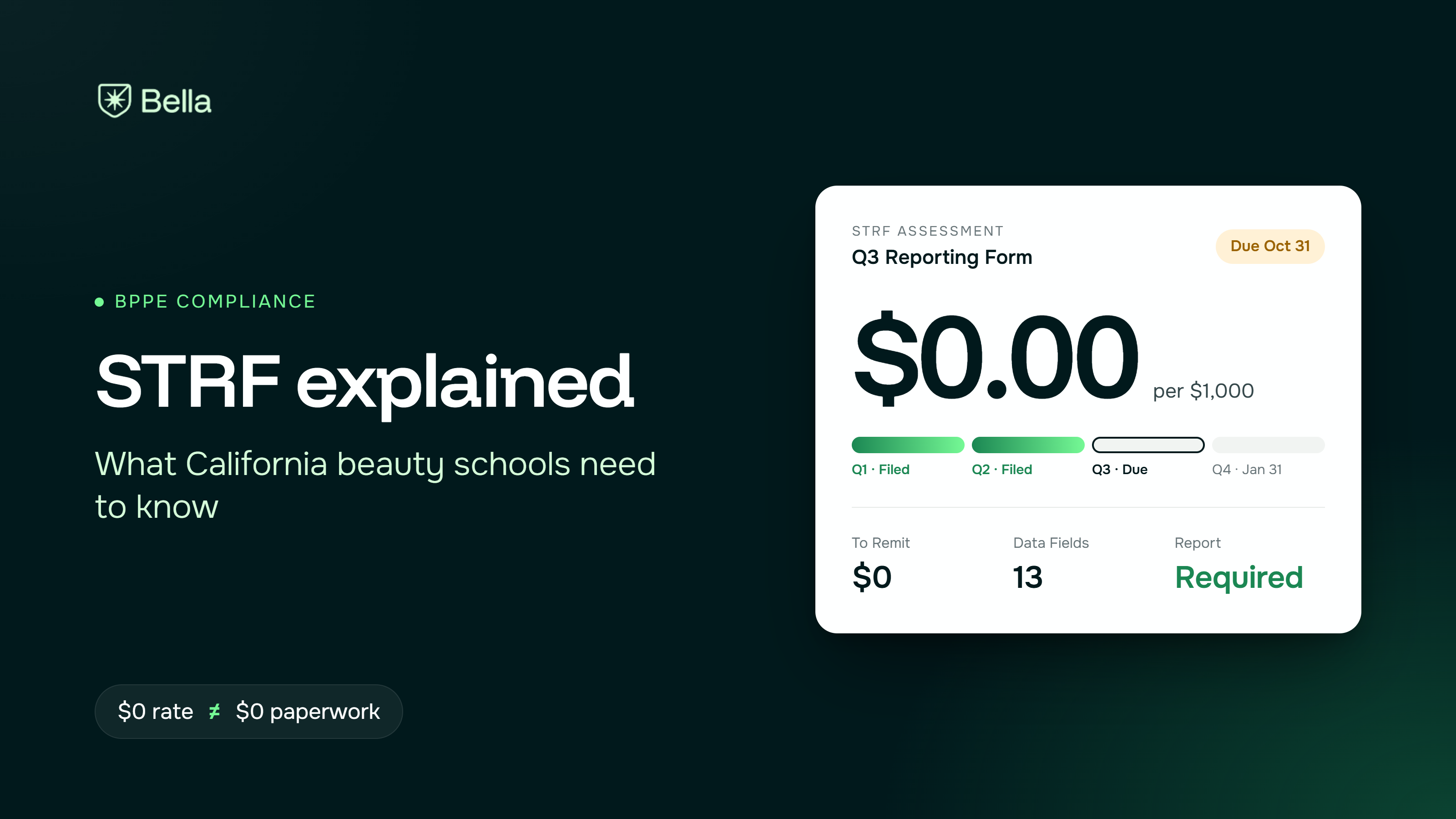
must be present. The School Performance Fact Sheet must be attached or referenced. If any of these elements are incomplete, the agreement is deficient. STRF disclosures. The enrollment agreement must include the required Student Tuition Recovery Fund language, and the school must document that the STRF assessment was collected (or that the student was exempt) at the time of the first payment. Even though the assessment rate was reduced to $0.00 per thousand dollars of institutional charges effective April 2024, the disclosure and collection process requirements remain in effect. Academic and attendance records. Grades, clock hours, and attendance documentation for the student's time at the school. Financial records. The student's financial ledger shows charges, payments, and any refunds.
What Inspectors Ask for Beyond Student Files After student files, inspectors move to institutional records. These are the documents that demonstrate your school is operating within its regulatory obligations at the organizational level.
School Performance Fact Sheet (SPFS) and Substantiating Data Inspectors will ask to see your published SPFS and then request the underlying records that support each figure. If your fact sheet reports a 78% graduation rate, they want to see the per-student data that produces that number. Under 5 CCR §74112, the substantiating data must cover enrollment counts, completion rates, licensure exam pass rates (first attempt), and job placement rates with employer documentation. This was the second most cited violation category in the 2025 data: schools published the fact sheet but had no records behind the numbers.
Graduate Placement Records Under §76140, schools must maintain individual employment records for each graduate: employment status, employer name, job title, start date, and compensation. Inspectors will request these records and cross-reference them against the placement rates on your SPFS. If the records do not exist, both the §76140 and §74112 requirements are unmet.
STRF Quarterly Reporting Inspectors may ask to see your STRF Assessment Reporting Forms for the most recent quarters. Even with the assessment rate at $0.00, schools must still complete and submit the quarterly reporting form to BPPE by the last day of the month following each quarter's close. Maintain copies of each submitted form.
School Catalog Your catalog must meet the minimum content requirements under CEC §94909 and 5 CCR §71810. Inspectors check for required disclosures, STRF language, refund policies, program descriptions, and accuracy against your current operations. If your catalog has not been updated to reflect changes in tuition, schedule, faculty, or program structure, that is a compliance gap.
Cancellation and Withdrawal Log Under 5 CCR §71750(f), schools must maintain a cancellation and withdrawal log. This is one of the items BPPE specifically lists as a common "notice to comply" violation. The log should document every student who cancelled or withdrew, including dates and any refund calculations.
The Organizational Readiness Checklist Having the right documents is only half the requirement. The other half is being able to produce them. Under §71930, records must be made immediately available during an inspection. If an inspector arrives and your staff cannot retrieve the requested files, the inability to produce records is itself a citable violation, separate from whatever might be wrong inside the files. Here is the operational readiness checklist: At least two staff members are designated and trained to retrieve student files, institutional records, and SPFS data during all operating hours. If only the owner can access records, your school has a single point of failure that BPPE has cited repeatedly. All student files (current, withdrawn, and graduated) are stored in a consistent, organized system where any authorized person can locate a specific student's file within minutes. Paper and digital systems both work as long as the retrieval process does not depend on one person's knowledge.
A copy of the current school catalog, the most recent SPFS for each program, the last four quarters of STRF reporting forms, and the cancellation/withdrawal log are stored in a single, accessible location. These are the institutional-level documents inspectors request first. The enrollment agreement template currently in use reflects all current regulatory requirements. If it has not been reviewed in the past 12 months, compare it against CEC §94902 and §94912 before the next enrollment.
The 15-Minute Drill The simplest way to know whether your school will pass an inspection: run one yourself. Pick nine student names at random (three current, three withdrawn, three graduated). Hand the list to a staff member who is not the owner or the primary records person. Ask them to produce the complete files in 15 minutes. If they can do it, and the files contain every required document, you are in good shape. If they cannot find the files, or the files are incomplete, those are the exact gaps an inspector will find. Run this drill quarterly. It takes less than 30 minutes and costs nothing. The schools that avoid citations are not the ones that study the regulations hardest. They are the ones that practice producing their records before someone asks for them under pressure.
Frequently asked questions ordered by popularity. Remember that if the visitor has not committed to the call to action, they may still have questions (doubts) that can be answered.
Not at all. We’ll move your data and guide your team. You’ll be ready to go in days, not weeks.
Yes. Bella is built for vocational schools and stays updated with state and federal rules.
Bella is made to be simple. If you can check email, you can use it. And we’re here to help whenever you need.
It helps spot missing info, flags risks early, and reminds you of what’s due—without you having to dig.
Yes. Pricing scales with your size, and most schools save time and money within the first month.
Absolutely. Bella uses encrypted, secure hosting and is fully FERPA compliant.
Tips, checklists, and insights for school owners and admins, written in plain language, not tech speak.