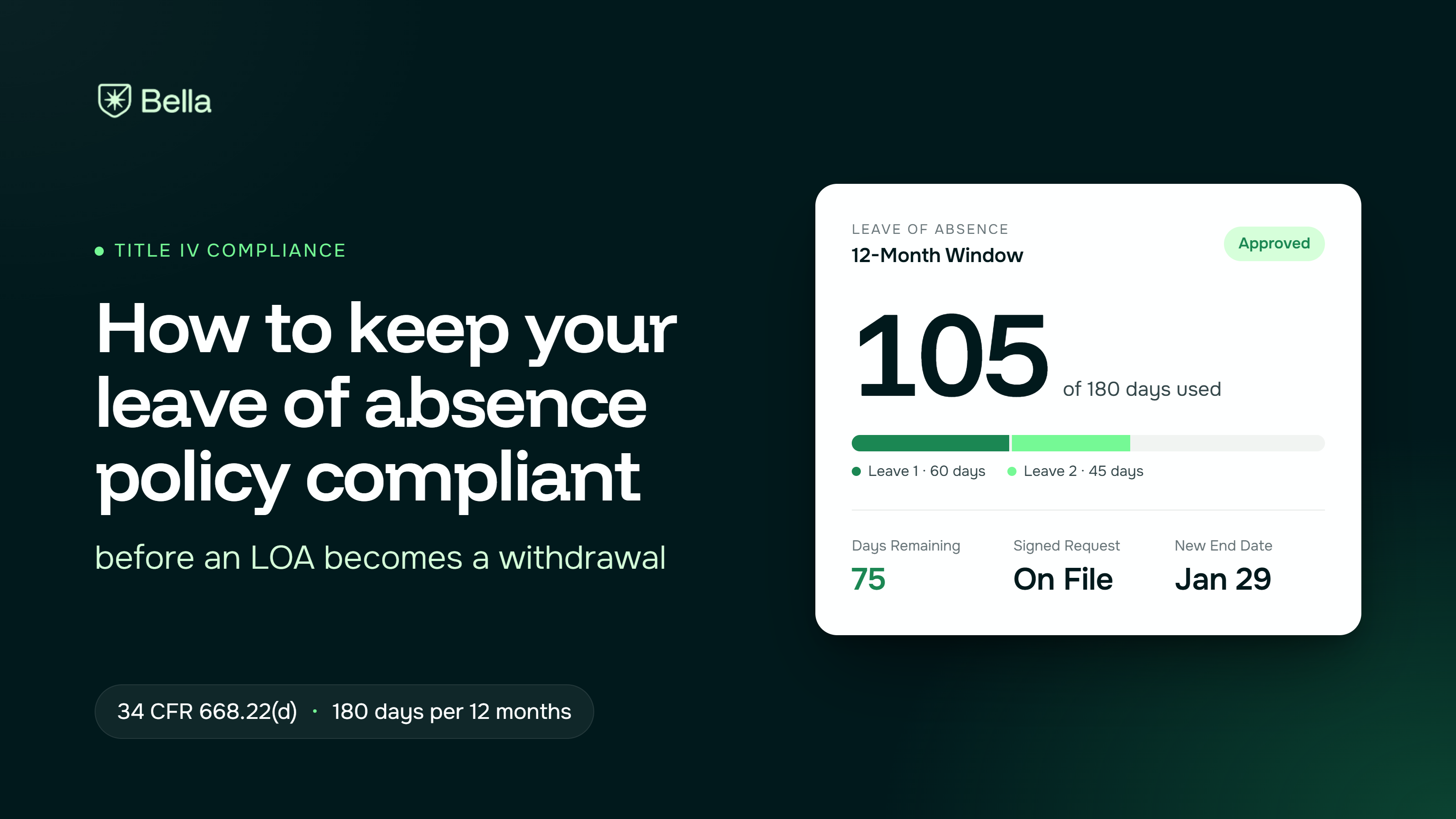
A leave of absence (LOA) is compliant for federal financial aid purposes only if it meets every condition in 34 CFR 668.22(d): a formal written policy, a signed and dated request that gives a reason, a reasonable expectation the student will return, no extra charges, and no more than 180 days of leave in any 12-month period. If any one condition fails, the student is treated as withdrawn from the date the leave began, and your school owes a Return of Title IV funds calculation.
This guide is for owners, directors, and financial aid or registrar staff at beauty and barber schools that enroll students using Title IV aid. If you are a student asking about your own leave, your school catalog sets the procedure.
An approved LOA is a temporary, documented break that the school does not have to treat as a withdrawal. The rule says an institution "does not have to treat a leave of absence as a withdrawal if it is an approved leave of absence," under 34 CFR 668.22(d).
The stakes are practical. A withdrawal starts the Return of Title IV funds (R2T4) calculation, which can require your school to return unearned aid.
It also affects the student's loan status, because an approved LOA keeps in-school status for loan borrowers. Getting the LOA right protects the student's aid and your audit file.
The regulation lists the requirements an LOA must meet. Each one needs evidence in the student file.
One exception helps with timing. If unforeseen circumstances, such as a medical emergency, prevent a prior written request, the school may grant the leave if it documents its decision and collects the written request later. Write down the circumstances on the day you approve.
For clock-hour programs, the rule also drops one condition that applies to other program types: the requirement that the student be allowed to complete coursework begun before the leave does not apply. You can still choose to require it in policy.
The cap counts calendar days, and the window is anchored to the first leave. A "12-month period" begins on the first day of the student's initial LOA, and days are counted from that date.
Example. A student starts a first leave on March 1, 2026 and returns after 60 days (March 1 to April 29). The 12-month window runs from March 1, 2026 through February 28, 2027. That student has 120 days left. A second leave of 120 days is allowed, bringing the total to 180. A second leave of 121 days brings the total to 181 and fails the condition.
Two checks catch most errors. Add every prior leave in the window, not only the most recent. And confirm the new leave ends inside the cap before approving it, not after. If a student asks to extend, treat the extension as a new approval that needs a written request and a fresh 180-day check.
There are two failure paths, and both lead to a withdrawal.
The leave never met the conditions. If a student takes a leave that does not satisfy 668.22(d), the withdrawal date is the date the leave began.
The student does not return. If the student does not resume attendance at or before the end of a compliant leave, the school must treat the student as withdrawn. The regulation sets different withdrawal dates for this situation, including the date the school determines the leave began, and the earlier of the leave end date or the date the student says they will not return. Which date applies depends on the school's circumstances, so confirm it in 668.22 and document your choice.
Either path starts an R2T4 calculation and the return deadlines that follow. Our compliance checklist lists LOA tracking under daily Title IV tasks for this reason, and the financial aid guide explains the aid programs those returns affect.
Federal rules decide whether a leave is a withdrawal. Your catalog decides how leave affects attendance and dates. A NACCAS-aligned example is Capri Beauty College's SAP policy, which states that the student returns in the same progress status as before leave, and hours elapsed during the leave extend the contract period by the same number of days and are not included in the cumulative attendance calculation.
Worked example. A contract end date of December 15, 2026 plus a 45-day LOA becomes January 29, 2027. If the policy also adjusts maximum time frame, record that new date. If it does not say so, a student can look late against the original dates when they are not.
State the treatment in your catalog, not only in staff habit. For how the attendance percentage is built, see our article on attendance percentages and the math behind them.
Use this list to audit your catalog language:
Each LOA file should hold:
Keeping these in one place matters for inspections too.
An LOA is compliant when the paperwork, the policy, and the dates all agree: a written and signed request, a documented return expectation, no added cost, a running 180-day tally, and updated contract and attendance records.
Miss one and the leave becomes a withdrawal with an aid return attached. Build the checklist into the approval step so staff cannot skip it.
If you want LOA days tallied automatically and flagged before a cap is crossed, book a Bella demo.
A student can be on approved leave for up to 180 days in total in any 12-month period under 34 CFR 668.22(d). The period begins on the first day of the first leave, and all approved leaves count toward the cap.
Not if it is an approved leave that meets every federal condition. If it does not, the student is treated as withdrawn, with the withdrawal date set to the day the leave began.
Under many NACCAS-aligned policies, no. Capri's policy excludes leave days from cumulative attendance and extends the contract end date by the same number of days. Your own written policy governs.
No, not if the school wants the leave to count as approved. Federal rules require that the leave not involve additional charges by the institution.
Frequently asked questions ordered by popularity. Remember that if the visitor has not committed to the call to action, they may still have questions (doubts) that can be answered.
Not at all. We’ll move your data and guide your team. You’ll be ready to go in days, not weeks.
Yes. Bella is built for vocational schools and stays updated with state and federal rules.
Bella is made to be simple. If you can check email, you can use it. And we’re here to help whenever you need.
It helps spot missing info, flags risks early, and reminds you of what’s due—without you having to dig.
Yes. Pricing scales with your size, and most schools save time and money within the first month.
Absolutely. Bella uses encrypted, secure hosting and is fully FERPA compliant.
Tips, checklists, and insights for school owners and admins, written in plain language, not tech speak.