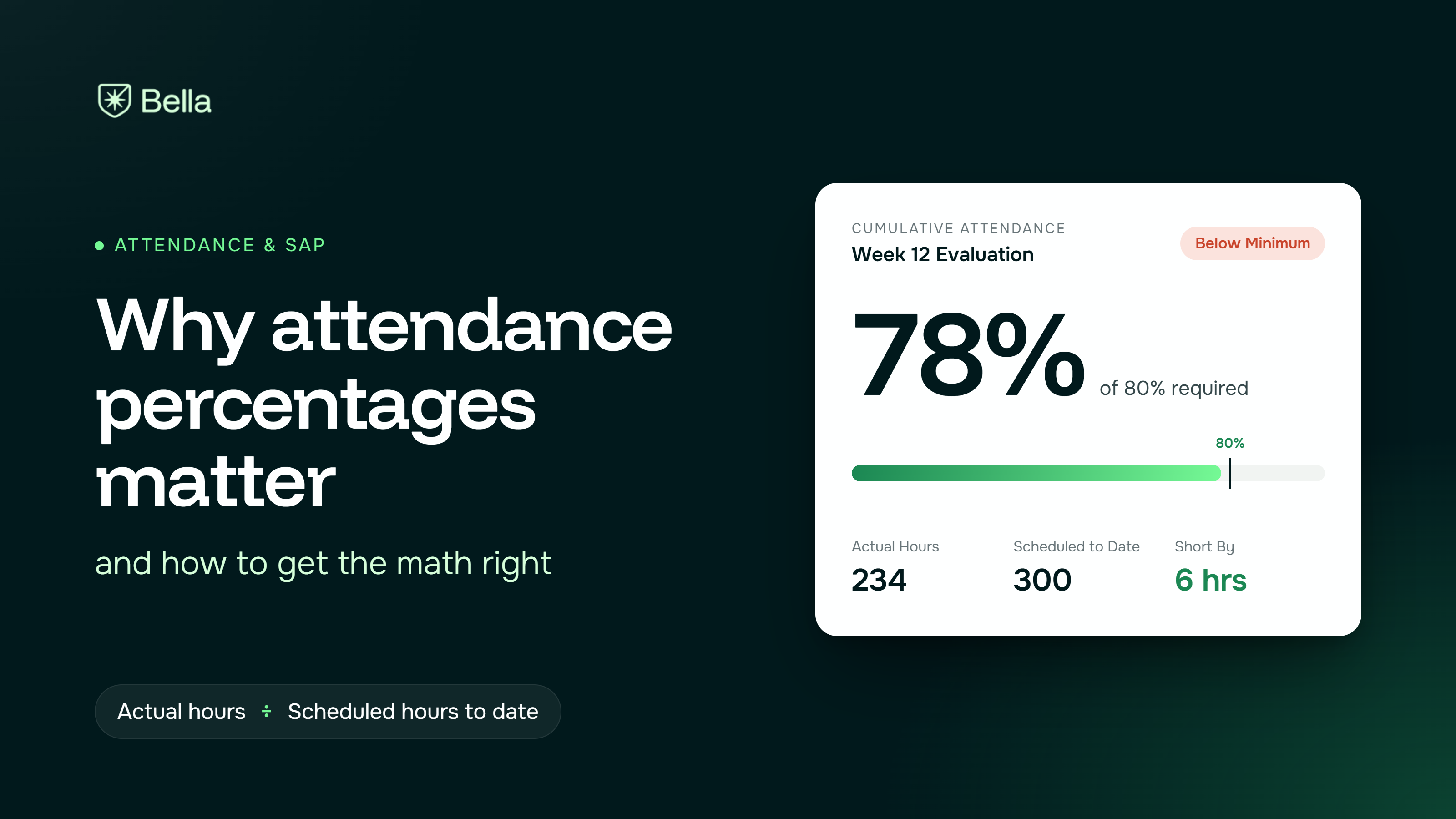

The standard formula divides total hours the student has attended by total hours the student was scheduled to attend up to the evaluation date. One school catalog states it plainly: divide the cumulative hours completed by the hours scheduled to date.
A NACCAS-aligned policy from Capri Beauty College uses the same logic and measures against the school's "hours possible based on the applicable attendance schedule."
Two details trip people up. First, the denominator is scheduled hours, not program hours. A student 200 hours into a 1,000-hour program is measured against the hours they were scheduled to attend so far, not against 1,000. Second, the figure is cumulative.
Each evaluation looks at the entire enrollment, so one bad month early in the program keeps dragging the number down at every later check.
A student is scheduled 25 hours per week. After 12 weeks, scheduled hours to date are 300. The student has logged 234 actual hours.
Attendance percentage = 234 ÷ 300 = 78%.
At an 80% minimum, this student fails the attendance test. To reach 80% by the same date, the student would have needed 240 hours, so 6 more hours would have changed the result. This is why a rounding rule matters. If your policy rounds to the nearest whole number, 79.5% passes. If it truncates, 79.5% fails. Dorsey's cosmetology policy, for instance, rounds cumulative attendance to the nearest whole number. Write your rule into the catalog.
Days and hours also diverge. A student who attends 40 of 50 scheduled days looks like 80%. If those 40 days averaged 5.5 hours against a 6-hour schedule, the real figure is 220 ÷ 300 = 73%. Late arrivals and early departures are invisible in a day count.
Attendance is the quantitative half of Satisfactory Academic Progress (SAP). Federal rules require a reasonable SAP policy that is evaluated at the end of each payment period for programs of one academic year or shorter, and at least annually for longer programs.
A student who fails an evaluation loses Title IV eligibility unless the school applies warning or probation status, and warning lasts one payment period only.
In practice, a policy like Capri's puts a student on warning after the first failed evaluation, probation after an approved appeal, and Title IV ineligibility after two consecutive failures without a successful appeal. Each step needs a dated, signed record. For the aid side of the picture, see our guide to Pell Grants, loans, and the 90/10 rule.
This is the point most explainers skip. The minimum attendance percentage and the maximum time frame are the same rule viewed from two sides.
Minimum attendance = 1 ÷ maximum time frame multiple.
The federal rule sets the ceiling: for an undergraduate clock-hour program, maximum timeframe may be no longer than 150% of the published program length (as of October 9, 2026). Schools can set a stricter limit. Capri uses 125% and states that an 80% attendance rate means the student will graduate within the maximum time frame allowed. A 1,500-hour program at 80% attendance needs 1,875 scheduled hours, which is exactly 125%.
If your catalog lists an 80% attendance minimum but a 150% maximum time frame, the two numbers contradict each other. An auditor can use that mismatch to question whether your policy is "reasonable" under the federal standard.
Hour errors compound across systems. Inaccurate attendance feeds Title IV payment period timing, NACCAS completion data, and licensure exam eligibility. Our beauty school compliance checklist breaks down how a single hour-tracking gap cascades into audit findings.
A leave of absence (LOA) is an approved, documented interruption in enrollment. Capri's policy states that hours elapsed during an LOA extend the contract period by the same number of days and are not included in the cumulative attendance calculation. That is the common approach, but each school's policy governs. If an LOA is not documented before the leave starts, the missed hours usually count as absences.
Makeup hours raise actual hours without changing scheduled hours. In the 78% example, 6 makeup hours move the student to exactly 80%. Verify that each makeup session is approved, dated, and tied to a specific absence.
Run this on 5 to 10 student files each month:
Student file completeness matters as much as the math.
Bella calculates hours automatically from digital check-ins, flags clock-in and clock-out gaps the same day, and surfaces students who are drifting toward a threshold before an evaluation date.
The goal is to replace manual arithmetic, which is where most of the errors above begin.
Attendance percentage is simple arithmetic with expensive consequences: actual hours over scheduled hours to date, cumulative, rounded the way your policy says, and consistent with your maximum time frame.
Fix the denominator, align the threshold with the time limit, and document every LOA and makeup session. Then the number holds up in an audit.
If you want attendance calculated and flagged automatically, book a Bella demo.
Most schools require at least 80% cumulative attendance, though published minimums range from about 67% to 90% across catalogs. The federal 150% maximum time frame implies a floor near 66.67%. Your school's catalog sets the number that applies to a student.
Divide the cumulative actual hours attended by the cumulative hours scheduled to date, then multiply by 100. For example, 234 actual hours out of 300 scheduled hours is 78%. Use hours, not days, and follow your policy's rounding rule.
NACCAS requires a SAP policy with an attendance element evaluated cumulatively, but the specific percentage varies by school. Confirm the current figure in the NACCAS Directory of Requirements or your accreditation contact.
Usually not. Common policies exclude LOA time from the attendance calculation and extend the contract end date by the days taken. Your written policy determines treatment, so state it in the catalog and enrollment agreement.
Frequently asked questions ordered by popularity. Remember that if the visitor has not committed to the call to action, they may still have questions (doubts) that can be answered.
Not at all. We’ll move your data and guide your team. You’ll be ready to go in days, not weeks.
Yes. Bella is built for vocational schools and stays updated with state and federal rules.
Bella is made to be simple. If you can check email, you can use it. And we’re here to help whenever you need.
It helps spot missing info, flags risks early, and reminds you of what’s due—without you having to dig.
Yes. Pricing scales with your size, and most schools save time and money within the first month.
Absolutely. Bella uses encrypted, secure hosting and is fully FERPA compliant.
Tips, checklists, and insights for school owners and admins, written in plain language, not tech speak.