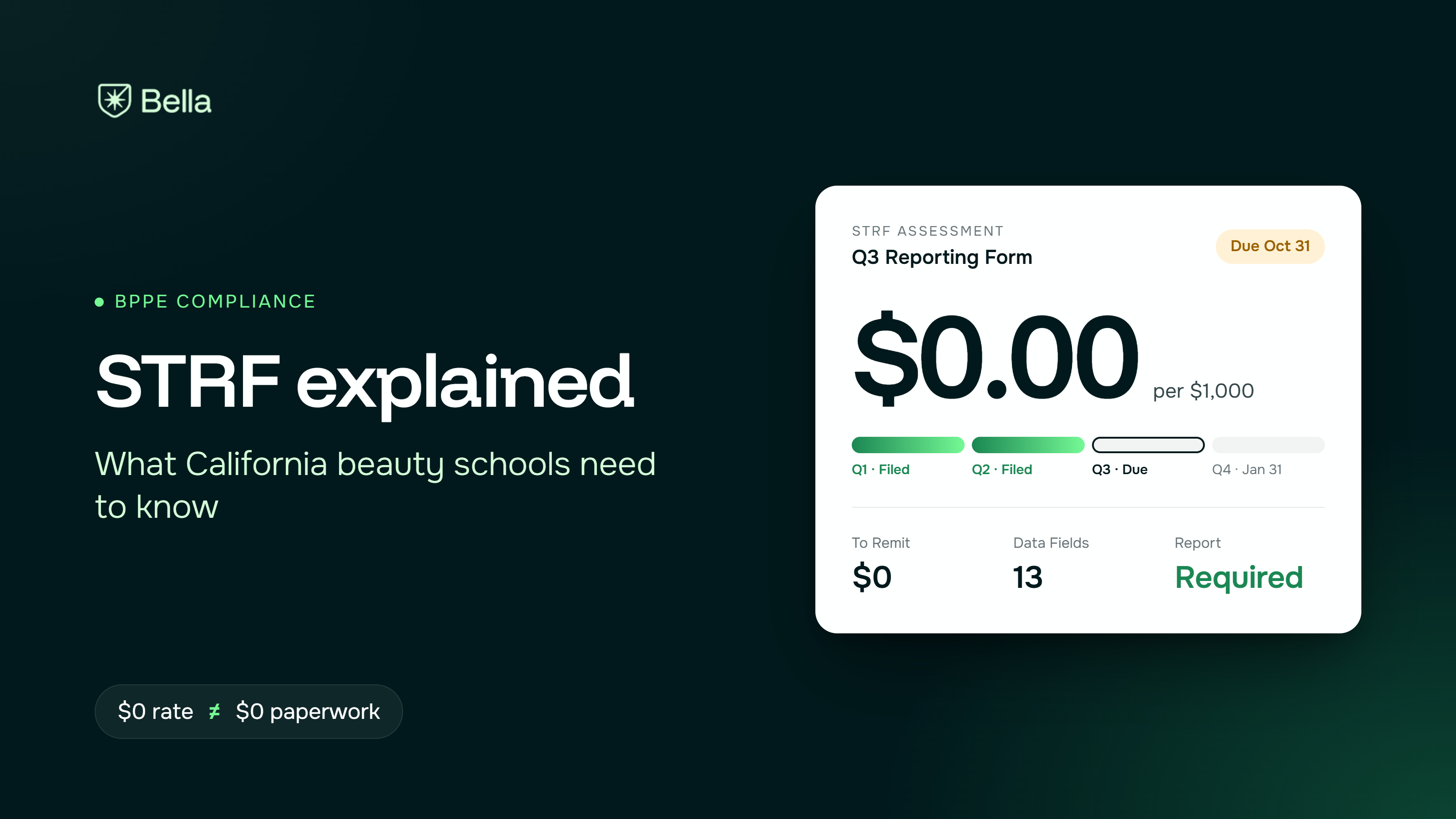
The Student Tuition Recovery Fund (STRF) is a California fund that reimburses students for economic loss when a Bureau for Private Postsecondary Education (BPPE) approved school fails them, most often by closing. Since April 1, 2024, the assessment schools collect has been $0.00 per $1,000 of institutional charges. The paperwork did not go to zero with it. The BPPE states that schools must still submit quarterly STRF reports and maintain specified student information for STRF-eligible students.
This guide is for owners, directors, and admissions or compliance staff at California beauty and barber schools. If your school operates outside California, STRF does not apply to your students.
STRF is a fund run by the BPPE that relieves or mitigates economic loss suffered by a student while enrolled at a qualifying institution, generally one approved or registered by the Bureau. At enrollment, the student must have been a California resident or in a California residency program, prepaid tuition, and suffered economic loss, according to the BPPE's STRF page.
Think of it as a safety net funded by schools through per-student assessments. If a school shuts down mid-program, STRF is how an eligible student can recover prepaid tuition. It also covers an "educational opportunity loss," which is a loss of third-party benefits such as Cal Grant, Pell Grant, or veterans' aid when the student cannot finish because the school closed or lost eligibility.
Only the dollar amount changed. Effective April 1, 2024, the assessment moved from $2.50 to $0.00 per $1,000 of institutional charges under 5 CCR section 76120. The BPPE says in the same notice that institutions must still complete all quarterly STRF Assessment Reporting Forms and maintain specified student information for STRF-eligible students.
Reading "$0" as "STRF is paused" is the most common mistake. A zero rate means there is nothing to collect or remit. It does not remove the disclosure, reporting, or record-keeping duties, and the BPPE has cited beauty schools for missing them.
The BPPE lists STRF disclosures as required in both the enrollment agreement and the school catalog under 5 CCR section 76215. The catalog statement must describe a student's rights and responsibilities, the purpose and operation of the fund, and how to file a claim, per California Education Code section 94909(a)(14).
Use the Bureau's exact wording. In inspection notices reviewed, the BPPE has required schools to correct a disclosure that was not verbatim.
Every STRF-qualifying institution submits the STRF Assessment Reporting Form each quarter, due by the last day of the month after the quarter closes (5 CCR section 76130). At a $0 rate, the payment line is zero, but the student counts still matter.
5 CCR section 76140 requires records that substantiate the report. The BPPE notices reviewed describe 13 fields per student, including ID number, name, email, several address types, enrollment agreement date, course and costs, STRF amount collected, the quarter remitted, third-party payer information, and total charges charged and paid.
Records must be electronic, orderly, available on site immediately, and produced within 14 calendar days of a written request. The wording comes from enforcement notices quoting the regulation, so check the current text of section 76140 before building your forms.
Your reporting counts only STRF-eligible students, so you need a documented eligibility call for each one. The next sections explain how.
Source: BPPE STRF page.
Put all four dates on the calendar in January. A report due October 31 covers July through September.
A student is STRF-eligible if they were a California resident when the enrollment agreement was signed, or were enrolled in a California residency program. Under 5 CCR section 76000, "California resident" means a person who resides in California at the time the enrollment agreement is signed.
Students who received a 100% refund under Education Code section 94919(d) or 94920(b) are excluded from the quarterly count, per the BPPE's reporting instructions. The fee itself is refundable only when a full refund is given.
Third-party payment (VA, Pell, Cal Grant) does not automatically remove a student from STRF records. The BPPE's guidance lists loss of third-party payer eligibility as a covered "educational opportunity loss." How a student whose charges are fully paid by a third party is treated for assessment is less clear in the sources reviewed. Ask the Bureau in writing if this affects many of your students.
The rate has moved repeatedly, which is why the $0 rate should not be treated as permanent. The BPPE's published chart shows the history:
Assessments were based on institutional charges rounded to the nearest $1,000. On a $16,000 program, the fee was $40.00 at $2.50 per $1,000, $8.00 at $0.50, and $0.00 today. The BPPE's own example: ten students each charged $1,600 round up to $2,000, giving $20,000 in assessable charges, and at the $0.50 rate that is $10.00.
Students who enrolled while a higher rate applied still have records tied to that rate. A tidy file keeps the enrollment date, the rate that applied, and the amount collected, even when the amount is zero.
BPPE inspection records show repeated citations in the same places. Missing or non-verbatim STRF disclosures in the enrollment agreement or catalog is one. Inability to produce STRF substantiating data in electronic form is another, and one notice cited a school that could not support two quarterly reports.
A third is a missing or late quarterly report. These items sit alongside the high-frequency file gaps missing when an inspector reviews current, withdrawn, and graduated files.
Because inspectors pull all three file types, STRF data on a student who left two years ago is still in scope.
Review this each quarter:
For a school-wide approach to keeping files complete, see our guide to managing student records and avoiding common BPPE citations.
STRF at $0 is a smaller bill, not a smaller obligation. Disclosures, quarterly reports, and 13 data points per eligible student remain, and the rate has changed five times since 2010. Build the process now so a future rate change is a one-cell update, not a rebuild.
If you want STRF fields captured at enrollment and quarterly reports ready on demand, book a Bella demo.
STRF stands for Student Tuition Recovery Fund. It is a California fund administered by the BPPE that relieves or mitigates economic loss for students at qualifying schools who are California residents and prepaid tuition.
Yes. The BPPE states that institutions must still submit all STRF Assessment Reporting Forms quarterly and maintain specified student information for STRF-eligible students, even though the rate is $0.00 per $1,000 (as of October 9, 2026).
The assessment rate changed from $2.50 to $0.00 per $1,000 of institutional charges effective April 1, 2024, under 5 CCR section 76120. One third-party site gives 2026 as the date, but BPPE's own page says 2024.
The school collects the assessment from the student with the first payment, then remits it with the quarterly report. At the current $0 rate, no amount is collected.
Frequently asked questions ordered by popularity. Remember that if the visitor has not committed to the call to action, they may still have questions (doubts) that can be answered.
Not at all. We’ll move your data and guide your team. You’ll be ready to go in days, not weeks.
Yes. Bella is built for vocational schools and stays updated with state and federal rules.
Bella is made to be simple. If you can check email, you can use it. And we’re here to help whenever you need.
It helps spot missing info, flags risks early, and reminds you of what’s due—without you having to dig.
Yes. Pricing scales with your size, and most schools save time and money within the first month.
Absolutely. Bella uses encrypted, secure hosting and is fully FERPA compliant.
Tips, checklists, and insights for school owners and admins, written in plain language, not tech speak.