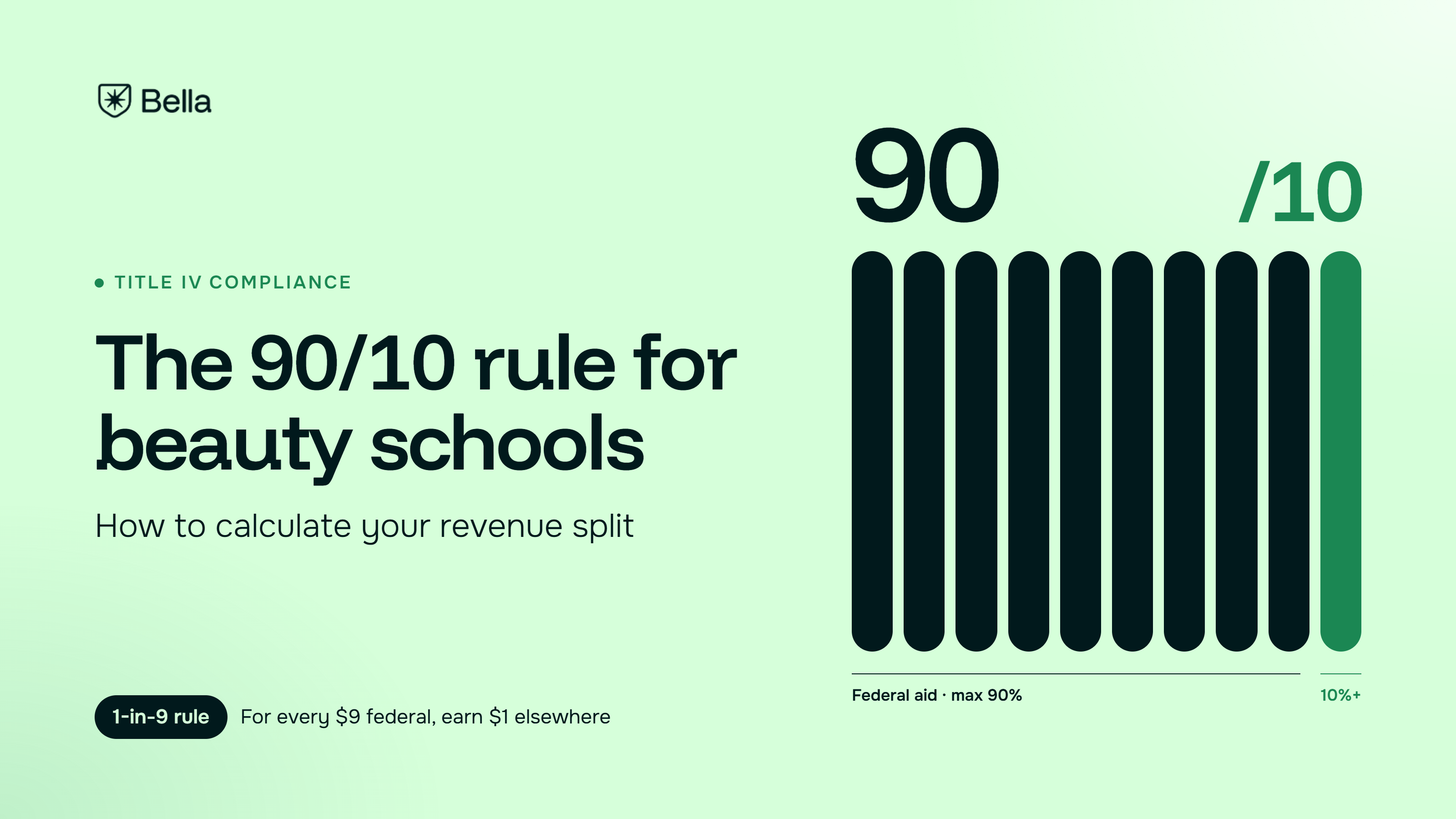
The 90/10 rule is the federal revenue split that requires a for-profit beauty or barber school to earn at least 10% of its revenue from non-federal sources, so no more than 90% can come from federal student aid and other federal education benefits. You calculate it once a year, on a cash basis, for your latest complete fiscal year. Fail it once and you become provisionally certified for two years. Fail it two years in a row and you lose access to Title IV aid (Pell Grants and Direct Loans) for at least two fiscal years.
This guide is for owners, directors, and financial aid staff at for-profit cosmetology, esthetics, and barber schools that take Title IV aid. If you run a nonprofit or public program, the 90/10 rule does not apply to you; start with our beauty school compliance checklist instead.
The rule lives in 34 CFR 668.28. Under current law, it applies only to proprietary institutions and requires them to derive at least 10 percent of their revenue from non-federal sources.
If your school is for-profit and participates in Title IV, it applies to you. Clock-hour schools are not exempt.
You report the result to the U.S. Department of Education (ED) every year. Schools disclose the federal and non-federal revenue amounts, by category, in a footnote to their audited financial statements.
Before 2023, only Title IV funds sat on the federal side. The American Rescue Plan Act of 2021 widened it, and ED’s October 28, 2022 final rule put that change into the regulation.
Now the federal side includes Pell Grants, Direct Loans, and other federal education benefits used for tuition and fees, such as VA education benefits. ED names the agencies and funds that count in a Federal Register notice and updates that list as needed.
One exception helps you: non-Title IV federal funds paid directly to a student for expenses other than tuition, fees, and institutional charges are left out.
This is where most beauty schools win or lose. The table below summarizes the regulation.
The point most explainers skip: your clinic floor. Generic 90/10 guides are written for colleges, so they ignore service revenue. For a beauty school, it can be the largest non-federal line. The regulation counts revenue from activities necessary for training if they are conducted on campus or at a facility the school controls, supervised by faculty, required of all students in the program, and directly related to services students perform. A cosmetology clinic floor built into the curriculum usually fits that description, but confirm the setup with your auditor.
The second trap: who pays first. The regulation presumes federal funds pay a student’s tuition and charges first, up to the amount of those funds. A student’s $500 cash payment only counts as non-federal if their charges exceed what Pell and loans already covered.
Here is a hypothetical for-profit cosmetology school with one fiscal year of cash received. These figures are illustrative, not industry data.
Federal share = $1,240,000 ÷ $1,395,000 = 88.9%. The school passes.
Now remove the clinic revenue, as a school would if its clinic setup didn’t meet the four conditions. $1,240,000 ÷ $1,335,000 = 92.9%. The school fails.
Use the 1-in-9 rule to find your floor. Minimum non-federal revenue = federal revenue ÷ 9. Here, $1,240,000 ÷ 9 = $137,778. The school has $155,000, a cushion of $17,222 (our arithmetic). That cushion is a few students’ worth of cash pay, which is why one enrollment class can tip the ratio.
The consequences escalate. All of these come from 34 CFR 668.28(c).
Failures are public. ED must disclose failing schools on College Navigator and report each proprietary school’s federal and non-federal revenue percentages to Congress by July 1 each year. ED’s 90/10 failure list covers fiscal years ending July 1, 2024 to June 30, 2025, with data as of May 15, 2026.
On March 10, 2026, ED updated its 90/10 Questions and Answers guidance without a formal announcement, generally reducing compliance burdens, according to a Cooley LLP alert (law-firm secondary source). The changes most relevant to beauty schools (as of October 17, 2026):
The sources disagree on one point. The new guidance says schools need not draw down Title IV funds by fiscal year end if disbursements are posted by then, but the regulation still requires schools on Advance Payment or HCM1 to request and disburse by year end. If you are on Advance Payment or Heightened Cash Monitoring 1 (HCM1), follow the regulation and confirm with your auditor.
On repeal: Rep. Mark Harris introduced the PARITY Act on July 2, 2026 to repeal the 90/10 rule, and noted that a House repeal was dropped from the Senate version of the bill that became law. Sen. Jim Banks introduced a Senate version. Until a bill passes, plan as if the rule stays.
Run these this week:
Bella, an AI school management system for beauty and barber schools, does not calculate your 90/10 ratio. That stays with your accountant or financial aid servicer. What Bella does is keep the records behind the numbers clean: enrollment documents collected digitally into each student’s file, and attendance hours calculated automatically from PIN clock-ins, which feed accurate withdrawal and R2T4 dates. See how this connects to federal aid at beauty schools.
The 90/10 rule is simple to state: at least one dollar in ten must come from outside federal programs. The hard part is knowing which dollars count, especially clinic revenue, VA benefits, and kit charges. Run the split quarterly so you have time to act before the fiscal year closes. If you are still planning a school, build the ratio into your startup cost model and your NACCAS accreditation roadmap.
If you want student records and hours that hold up when your auditor builds the 90/10 footnote, book a Bella demo.
No. The 90/10 rule applies only to proprietary (for-profit) schools that participate in Title IV federal student aid. Nonprofit and public cosmetology programs are not subject to it.
Yes. For fiscal years beginning on or after January 1, 2023, VA education benefits used for tuition and fees count on the federal (90) side of the 90/10 calculation. Before 2023, they counted as non-federal revenue.
Yes, if the clinic meets four conditions. The services must be on campus or at a facility the school controls, supervised by faculty, required of all students in the program, and directly related to services students perform. Confirm your setup with your auditor.
After one failed year, the school must report the failure to ED within 45 days, notify students, and becomes provisionally certified for two fiscal years. After two consecutive failed years, the school loses Title IV eligibility for at least two fiscal years.
Frequently asked questions ordered by popularity. Remember that if the visitor has not committed to the call to action, they may still have questions (doubts) that can be answered.
Not at all. We’ll move your data and guide your team. You’ll be ready to go in days, not weeks.
Yes. Bella is built for vocational schools and stays updated with state and federal rules.
Bella is made to be simple. If you can check email, you can use it. And we’re here to help whenever you need.
It helps spot missing info, flags risks early, and reminds you of what’s due—without you having to dig.
Yes. Pricing scales with your size, and most schools save time and money within the first month.
Absolutely. Bella uses encrypted, secure hosting and is fully FERPA compliant.
Tips, checklists, and insights for school owners and admins, written in plain language, not tech speak.