Gainful employment is the federal requirement that certificate programs, and nearly every program at a for-profit school, must prepare students for “gainful employment in a recognized occupation” to stay eligible for Title IV federal student aid. Under the final rule the Department of Education published on July 1, 2026, that requirement is measured by one earnings test. Your program’s graduates, four years after completing, must earn more than working adults aged 25 to 34 with only a high school diploma. Fail two years out of three and the program loses federal Direct Loans. If that program enrolls most of your Title IV students, the school can lose Pell Grants too.
This guide is for owners, directors, and financial aid staff at cosmetology, barber, and esthetics schools that participate in Title IV. If your school does not take federal aid, the earnings test does not apply to you, though your state and accreditor may still look at graduate outcomes.
The phrase comes from the Higher Education Act’s definition of an eligible school. Federal regulations define a proprietary institution as one that provides an eligible program of training to prepare students for gainful employment in a recognized occupation.
So the label applies to you whether or not anyone measures it. What has changed over the years is how the Department of Education (ED) decides whether a program actually prepares students for paying work.
GE programs are all programs at for-profit (proprietary) schools and non-degree certificate programs at public and nonprofit schools. A 1,000-hour cosmetology program at a for-profit academy is covered. So is a barber certificate at a community college.
ED itself counts four earlier GE regulations before the current one. Here is the short version.
The 2026 change matters for one reason: the earnings test is now written into statute. Earlier GE rules were agency regulations and changed with each administration. Duane Morris notes (a law firm alert) that changing this framework would now take congressional action or a court order.
A program passes if the median annual earnings of its completers equal or exceed the earnings threshold. For undergraduate programs, the threshold is the median earnings of working adults aged 25 to 34 with only a high school diploma, in your state. If fewer than half of your students come from your state, ED uses a national figure.
Three details shape the result:
Worked example (hypothetical numbers). Your state’s threshold is $30,000. The IRS reports a median of $27,400 for your cosmetology completers.
$27,400 − 30,000=-2,600.
The program fails by 2,600 or 8.7% of the threshold (2,600 ÷ $30,000).
ED publishes the real threshold for each state every year.
After a first failure, ED sends a warning. You then have three options, and you can only choose the first two after the first failure:
Students must also be told. Enrolled students get a warning within 30 days of ED’s notice. Prospective students cannot enroll, sign a financial commitment, or receive a disbursement until they acknowledge the warning.
Most coverage says failing programs “lose loans.” For a beauty school, that undersells the risk.
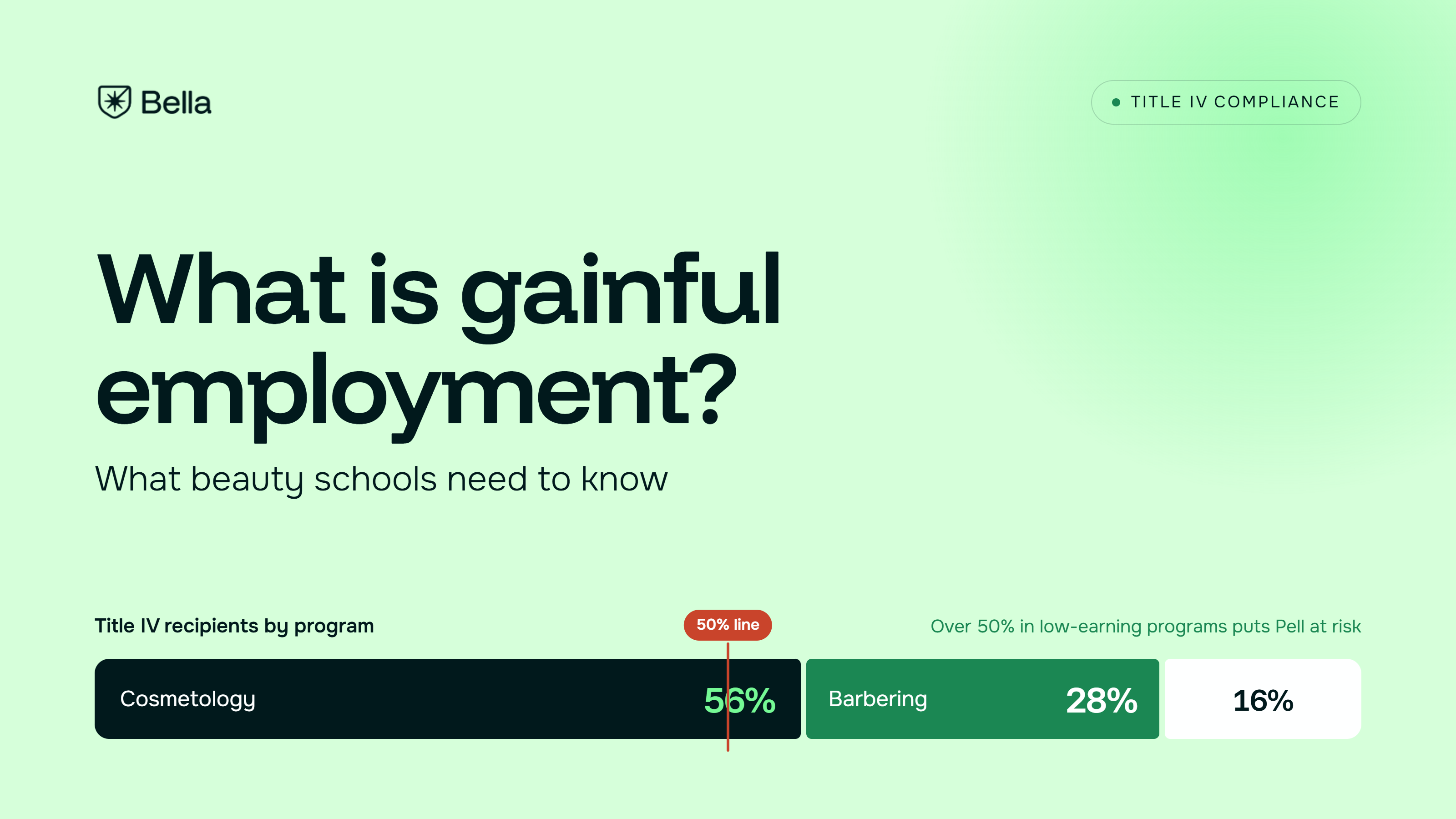
ED’s administrative capability rule says a low-earning outcome program loses all Title IV aid, including Pell, if more than half of the school’s Title IV recipients, or more than half of its Title IV dollars, are in low-earning programs.
Example 1: single-program school. You offer only cosmetology. 140 Title IV recipients, all 140 in cosmetology. 140 ÷ 140 = 100 percent. If cosmetology becomes low-earning, the program fails the 50 percent test automatically, and Pell goes with the loans.
Example 2: three programs. You have 90 recipients in cosmetology, 45 in barbering, and 25 in esthetics (160 total). If cosmetology becomes low-earning: 90 ÷ 160 = 56.25 percent. That is over half, so cosmetology loses Pell too. If only barbering becomes low-earning: 45 ÷ 160 = 28.1 percent. Barbering loses Direct Loans but keeps Pell.
There are two exits. Schools that have not participated in Direct Loans for the five most recently completed award years are exempt from the Pell consequence, and so are programs whose school agrees to block Direct Loan borrowing for at least five years. If your students rely mainly on Pell, that is a real strategic choice. Our guide to financial aid, Pell Grants, and the 90/10 rule covers how those funding sources fit together.
The last row is our arithmetic, not an ED date. Cosmetology and barbering get no pass or fail result while ED uses 2025 earnings, so the first result that counts would come in early 2028. A second failure in early 2029 would make the program low-earning starting in 2029-30.
The sources disagree on two points. First, ED’s fact sheet treats some provisions as effective July 1, 2026, while Duane Morris describes July 1, 2027 as the effective date, with early reporting optional. Second, ED calls the tipped-occupation delay one year, while Duane Morris says small pooled programs could see up to four years of informational-only results. Confirm your school’s timeline with your Title IV compliance consultant or ED.
Bella, an AI school management system for beauty and barber schools, keeps enrollment documents, attendance hours, and student status in one profile, so a completion date is entered once and matches everywhere. When ED sends your completer list, you check it against one record instead of three spreadsheets. Our guide to managing student records effectively covers the record-keeping side in more detail.

Gainful employment means your programs must lead to paying work, and ED now measures that by comparing graduate earnings to high school earnings in your state. You cannot change your 2021 graduates’ tax returns, but you can make sure the right students are on the list and run the 50 percent math this month. For the test itself in more depth, read our 2026 Earnings Test explainer.
If you want completion and withdrawal records you can defend in a 60-day correction window, book a Bella demo.
Yes. Gainful employment is a requirement in the Higher Education Act, so cosmetology and barber programs at for-profit schools remain GE programs. What changed on July 1, 2026 is the measure: the debt-to-earnings test was dropped, and programs now face a single earnings test.
The gainful employment earnings threshold for undergraduate programs is the median earnings of working adults aged 25 to 34 with only a high school diploma, usually in the school’s state. ED publishes the figure each year. A program passes if its completers’ median earnings, four years after completion, equal or exceed it.
Yes, in some cases. If more than half of a school’s Title IV recipients or Title IV dollars are in low-earning outcome programs, those programs lose all Title IV aid, including Pell Grants. Schools that have not used Direct Loans for five completed award years, or that agree to block Direct Loan borrowing for five years, are exempt from that consequence.
Only reported tips count, because the gainful employment earnings test uses federal tax data. This is why ED delayed pass or fail results for cosmetology, barbering, and other tipped occupations until it uses 2026 or later tax data, after the “No Tax on Tips” policy took effect. Encouraging graduates to report all tip income can affect your program’s measured earnings.
Frequently asked questions ordered by popularity. Remember that if the visitor has not committed to the call to action, they may still have questions (doubts) that can be answered.
Not at all. We’ll move your data and guide your team. You’ll be ready to go in days, not weeks.
Yes. Bella is built for vocational schools and stays updated with state and federal rules.
Bella is made to be simple. If you can check email, you can use it. And we’re here to help whenever you need.
It helps spot missing info, flags risks early, and reminds you of what’s due—without you having to dig.
Yes. Pricing scales with your size, and most schools save time and money within the first month.
Absolutely. Bella uses encrypted, secure hosting and is fully FERPA compliant.
Tips, checklists, and insights for school owners and admins, written in plain language, not tech speak.