The gainful employment rule you are searching for no longer exists in its old form. In July 2026 the Education Department replaced the debt-to-earnings test with a single earnings test for every Title IV program. A program that fails it two years out of three loses Direct Loans, and a school can lose all federal aid.
Cosmetology programs get a delay, not an exemption. Here is how the test works and what to do before the first results post.
The Education Department published its final rule on July 1, 2026, after announcing it on June 29. It is titled "Student Tuition and Transparency System (STATS) and Earnings Accountability." It replaces the former financial value transparency and gainful employment debt-to-earnings framework with one measure, the earnings premium.
The debt-to-earnings test is gone. According to the Department's fact sheet, the new framework applies to postsecondary programs "regardless of institutional tax status or credential level," including undergraduate certificate programs like cosmetology and barbering.
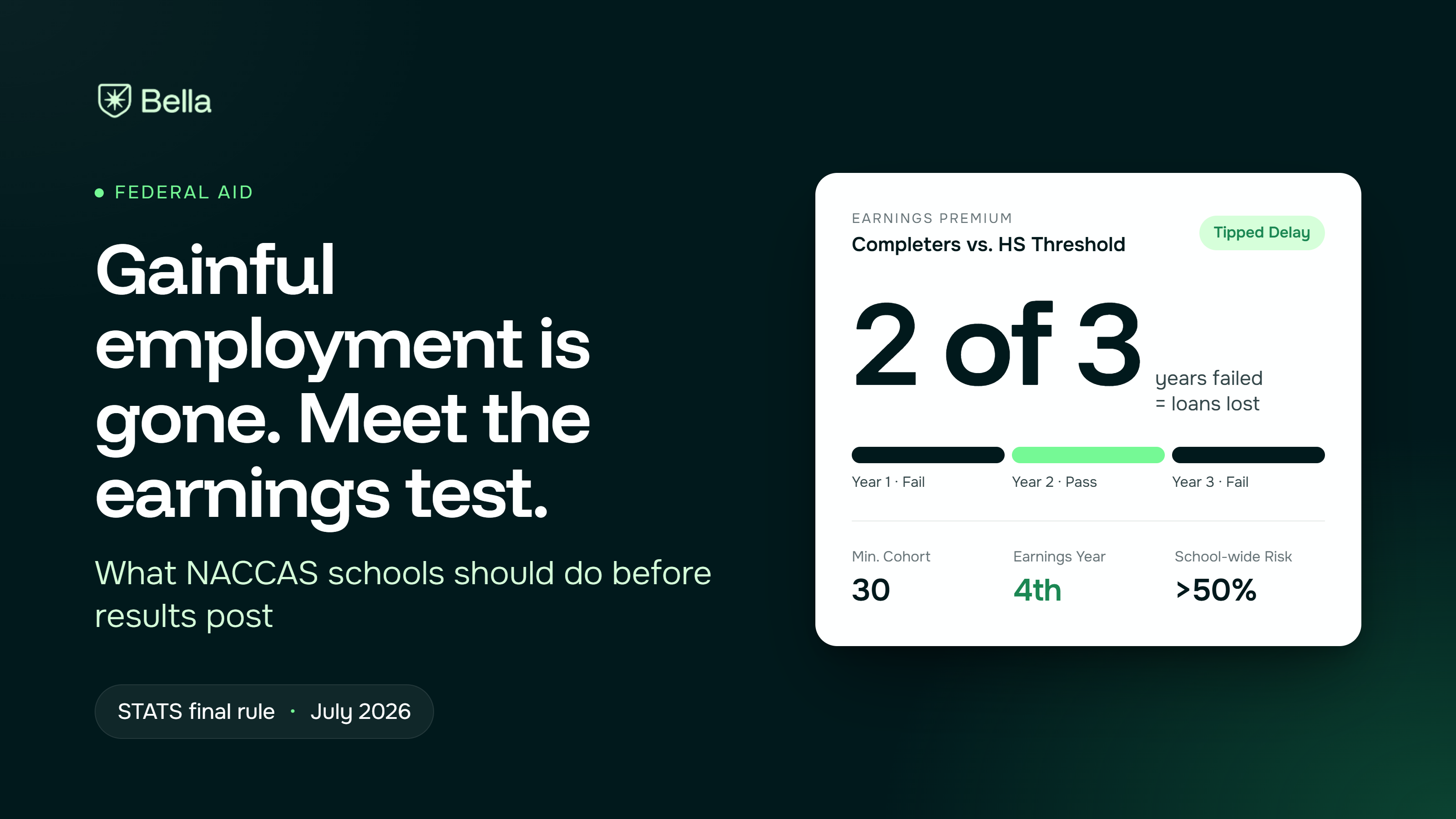
A program passes if the median annual earnings of its completers equal or exceed a threshold, and fails if they fall below it. For undergraduate programs, the threshold is the median earnings of working adults aged 25 to 34 with only a high school diploma. It uses state data, or national data if fewer than 50 percent of your students come from your state.
Earnings are measured in the fourth tax year after completion, one year later than under the old rule. The Department gets them from the IRS, which returns an aggregate median for each program's completer list. Your school never sees individual earnings.
Here is the part that matters for a small school. The measure uses a cohort of at least 30 completers. If your program graduated fewer than 30 students in one year, the Department adds prior years of the same program, then broader programs in the same field, until it reaches 30.
One failure triggers a warning. Two failures in any three consecutive award years makes the program a "low-earning outcome program," and it loses Direct Loan eligibility.
The bigger risk is school-wide. An institution loses all Title IV aid, including Pell Grants, if more than half of its Title IV recipients, or more than half of its Title IV dollars, sit in low-earning outcome programs. For a school with one dominant cosmetology program, that line is easy to cross.
After a first failure, a school has three options under the final rule:
Appeals are limited to calculation errors and must be filed within 30 days of a low-earning determination. The Department said it will not accept alternate earnings data on appeal.
Programs tied to occupations where most workers report tips get a delay. The rule uses the IRS list of "No Tax on Tips" occupations, and the Department says cosmetology, barbering, and massage therapy programs qualify.
During the delay, these programs are not counted as passing or failing for award years that rely on earnings data from tax year 2025 or earlier. The Department still publishes their earnings data and the threshold. The reasoning is that the new tax treatment of tips should show up in later earnings data.
Treat the delay as a head start. Your numbers will be public before they count against you, and prospective students will see them.
The sources disagree on two points. The Department's fact sheet says the first STATS submission was due October 1, 2026.
Duane Morris ties first reporting to October 1 after the July 2027 effective date, with early implementation optional. Confirm with Federal Student Aid or counsel which applies to your school, since today is after October 1.
The earnings test is a federal measure, but your accreditor is under the same pressure. In July 2026 a federal advisory panel voted 9 to 3 to recommend denying NACCAS renewed recognition, citing graduate earnings, debt, and probation rates among its schools. The final decision is pending.
Duane Morris notes the Department has told accreditors in recent reviews that it expects them to weigh low-earnings outcomes.
So the same numbers can reach you twice: once through the Department and once through your accreditor.
Beauty school groups argue the law does not reach certificate programs. The American Association of Cosmetology Schools and others say the statute omits undergraduate certificates, and that the Department used its older gainful employment authority to extend the test anyway.
The Department's fact sheet says the test applies to certificate programs, and its preamble defends that authority.
I could not confirm any court ruling on this. Plan as if the rule applies. If a court changes that, you will have lost nothing by getting your data clean.
You cannot change IRS earnings. You can control who is on your completer list, and that list is one of the few appealable inputs.
Your compliance checklist should now include a quarterly completer audit.
The earnings test looks like a problem you cannot influence. Most of it is, but the completer list is yours. Pull last year's graduates today and check every status against the file.
Want to see how Bella tracks completions, withdrawals, and program data in one place? Book a demo.
Frequently asked questions ordered by popularity. Remember that if the visitor has not committed to the call to action, they may still have questions (doubts) that can be answered.
Not at all. We’ll move your data and guide your team. You’ll be ready to go in days, not weeks.
Yes. Bella is built for vocational schools and stays updated with state and federal rules.
Bella is made to be simple. If you can check email, you can use it. And we’re here to help whenever you need.
It helps spot missing info, flags risks early, and reminds you of what’s due—without you having to dig.
Yes. Pricing scales with your size, and most schools save time and money within the first month.
Absolutely. Bella uses encrypted, secure hosting and is fully FERPA compliant.
Tips, checklists, and insights for school owners and admins, written in plain language, not tech speak.