STRF substantiating data is the student-level record that California schools must keep under 5 CCR § 76140 to back up every quarterly Student Tuition Recovery Fund (STRF) Assessment Reporting Form. For each STRF-eligible student, that record has 13 fields. The requirement did not end when the STRF assessment dropped to $0.00 per $1,000 of institutional charges on April 1, 2024. The quarterly form is the summary, and the 13 fields are the proof behind it. If the proof is missing, the Bureau for Private Postsecondary Education (BPPE) can cite you even if you have never collected a dollar of STRF.
This guide is for owners, admissions, registrar, and compliance staff at California cosmetology, esthetics, and barber schools who enroll students and file STRF reports. If you are preparing for a full inspection, start with our BPPE inspection checklist.
STRF substantiating data is the evidence behind the numbers you report. Each quarter your form states how many STRF-eligible students signed enrollment agreements and how much in institutional charges they were assessed on. If BPPE asks you to prove those figures, you produce the student-level records.
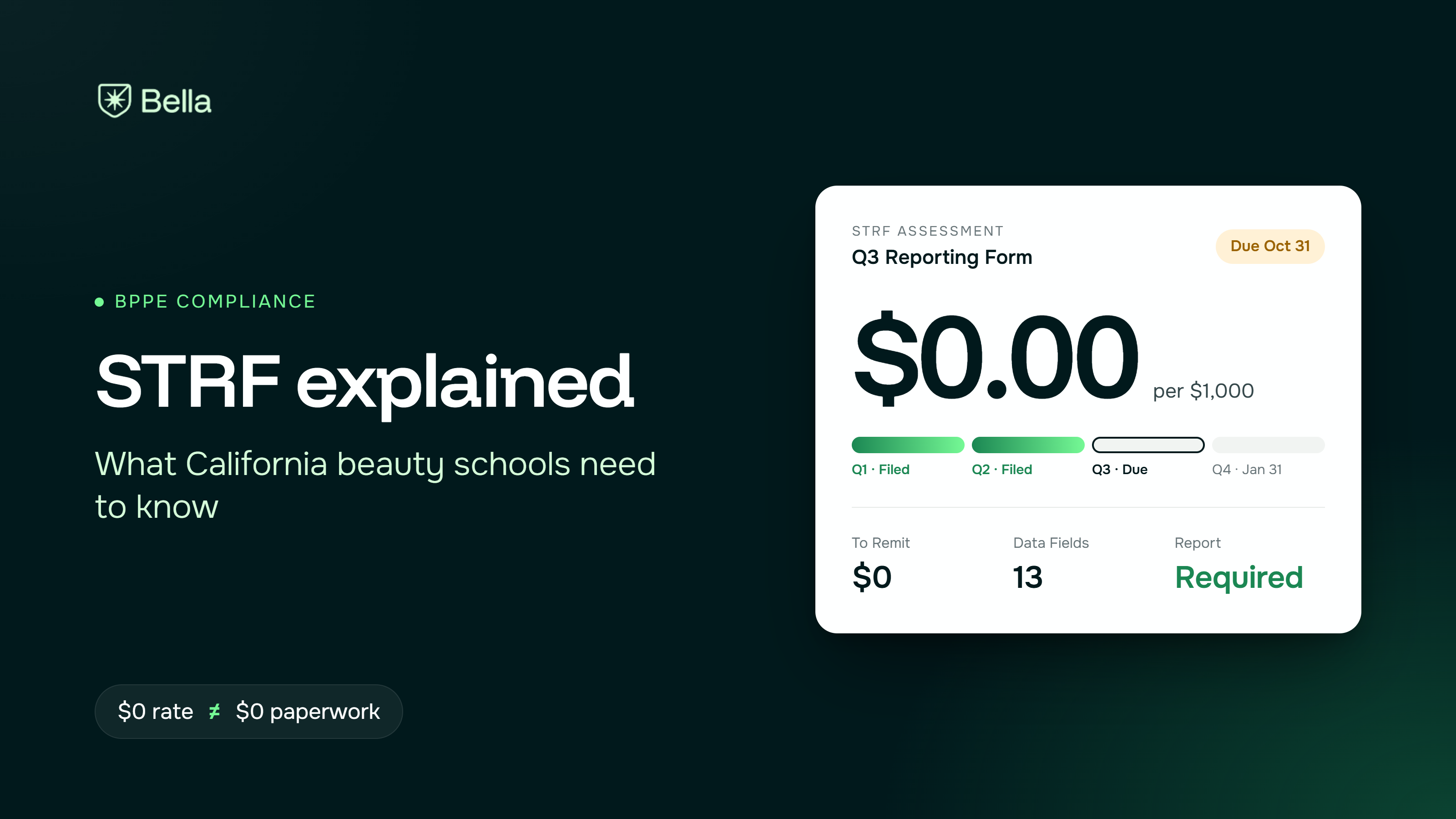
Many schools read the $0 rate as “STRF is paused.” It is not. BPPE’s 2024 rate notice makes clear that the end of fee collection did not end quarterly reporting or record-keeping for eligible students.
Enforcement is current and specific to beauty schools. In June 2025, BPPE issued a citation order to Straight Perm Beauty School.com in Los Angeles that included a request for the school’s STRF records.
The fields come straight from 5 CCR § 76140(a). Track each one as its own column, not merged into another field.
The point most explainers skip: fields 4, 5, and 6 are three separate addresses, and field 5 is the one that matters for eligibility. It shows where the student lived when they signed, which is what makes them a California resident for STRF purposes. If you overwrite it when a student moves, you lose your residency evidence.
BPPE has cited schools that kept a “permanent address” but did not record which kind of address it was. A column labeled only “address” is not enough.
Suppose you report 25 STRF-eligible enrollments in Q2. Then 25 × 13 = 325 data points must exist behind that one form. One blank cell in one student’s row means the form is not fully substantiated.
Fields 12 and 13 often differ, and that is fine. A student on a payment plan with $14,000 in institutional charges who has paid $5,600 so far shows $14,000 in field 12 and $5,600 in field 13.
The STRF rate is set per $1,000 of institutional charges, rounded to the nearest $1,000. BPPE’s form instructions give the rule: charges under $1,000 round to $0, charges up to $1,499.99 round down to $1,000, and $1,500.00 or more rounds up to $2,000. The same pattern applies at every thousand.
At a $0 rate, the assessment is $0 no matter what the charges are. You still report the rounded charges.
A student is generally STRF-eligible if they were a California resident when they signed the enrollment agreement, or if they are enrolled in a residency program. Eligibility is what triggers the 13-field record, so record it at enrollment for every student.
Third-party payers are where schools get confused. Under 5 CCR § 76120(b), a student whose costs a third party pays directly to the school does not pay the STRF assessment, unless the student has a separate agreement to repay that third party. That is exactly why field 11 exists. Record the payer for every student who has one, and confirm with BPPE how payer-funded students should be counted on your form.
Electronically, and in a way an inspector can read without your staff explaining it. Section 76140(b) requires the records to be immediately available to a BPPE representative at a site inspection and provided in electronic format. BPPE has cited schools that had the data but could not produce it electronically.
A well-built spreadsheet can meet the rule. The risk is drift: fields get skipped, versions conflict, and nobody notices until an inspector asks. Keep one master file, give each of the 13 fields its own column, and add each student’s row on the day they enroll.
You file an STRF Assessment Reporting Form every quarter, even at $0. The form reports totals such as the number of students who signed enrollment agreements, the number who are STRF-eligible, and their rounded institutional charges.
Dates are as of October 18, 2026. BPPE has repeatedly cited beauty schools simply for not filing these forms, so the filing is as much a risk as the data.
For the full inspection picture, use our beauty school compliance checklist. Field 7 depends on a correctly dated agreement, which our BPPE enrollment agreement requirements guide covers.
Bella is an AI school management system for beauty and barber schools. Students enter their details and upload documents from their phone during digital enrollment, and everything lands in their student profile, so the source information for your STRF fields is collected once, at the start. Bella keeps the student file. Your school still owns the quarterly filing, and someone should be named responsible for it. For more on records that hold up at inspection, read how to manage student records and avoid BPPE citations.
STRF at $0 still means 13 fields per eligible student, stored electronically, backing a form filed every quarter. Add each student’s row the day they enroll, and the quarterly form takes minutes instead of a weekend.
If you want enrollment data captured once and kept in one student profile, book a Bella demo.
Yes. California beauty schools must still file the STRF Assessment Reporting Form every quarter and keep 5 CCR § 76140 records for every STRF-eligible student, even though the assessment has been $0.00 per $1,000 since April 1, 2024. Only fee collection stopped.
The 13 STRF substantiating data fields under 5 CCR § 76140(a) are:
STRF Assessment Reporting Forms are due April 30, July 31, October 31, and January 31, each covering the previous calendar quarter. The deadlines apply even when no STRF assessment is collected.
No. Under 5 CCR § 76140(b), STRF substantiating data must be provided to BPPE in electronic format and made available immediately during a site inspection. BPPE has cited schools that had the information but could not produce it electronically.
Frequently asked questions ordered by popularity. Remember that if the visitor has not committed to the call to action, they may still have questions (doubts) that can be answered.
Not at all. We’ll move your data and guide your team. You’ll be ready to go in days, not weeks.
Yes. Bella is built for vocational schools and stays updated with state and federal rules.
Bella is made to be simple. If you can check email, you can use it. And we’re here to help whenever you need.
It helps spot missing info, flags risks early, and reminds you of what’s due—without you having to dig.
Yes. Pricing scales with your size, and most schools save time and money within the first month.
Absolutely. Bella uses encrypted, secure hosting and is fully FERPA compliant.
Tips, checklists, and insights for school owners and admins, written in plain language, not tech speak.