The enrollment agreement is the single most scrutinized document in a BPPE inspection. Inspectors review it in every student file they pull. When it is incomplete, improperly signed, or outdated, the citation follows. In the second half of 2025, enrollment agreement deficiencies were among the top five violation categories for California barber and beauty schools. This article walks through every element the Bureau requires in an enrollment agreement, where schools most commonly fail, and how to build a process that keeps your agreements compliant.
What CEC §94902 Requires in the Agreement The California Education Code Section 94902(b) defines the mandatory contents of an enrollment agreement. Each item below must be present in the document. If any is missing, the agreement is deficient: The name of the institution and the school code assigned by BPPE. The student's name and address. The program title, the number of clock hours or credit hours, and a description of the credential the student will receive upon completion. The total charges for the program, broken down by category: tuition, registration fee, equipment and supply costs, STRF assessment, and any other fees. Each charge must be itemized, not bundled into a single total. The payment schedule and the method of payment (cash, loan, financial aid, or a combination). If the student is using a loan, the agreement must include the total amount of the loan, the interest rate, and the total amount the student will owe upon completion of repayment. The institution's refund and cancellation policy includes the specific formula used to calculate a refund if the student withdraws before completing the program.
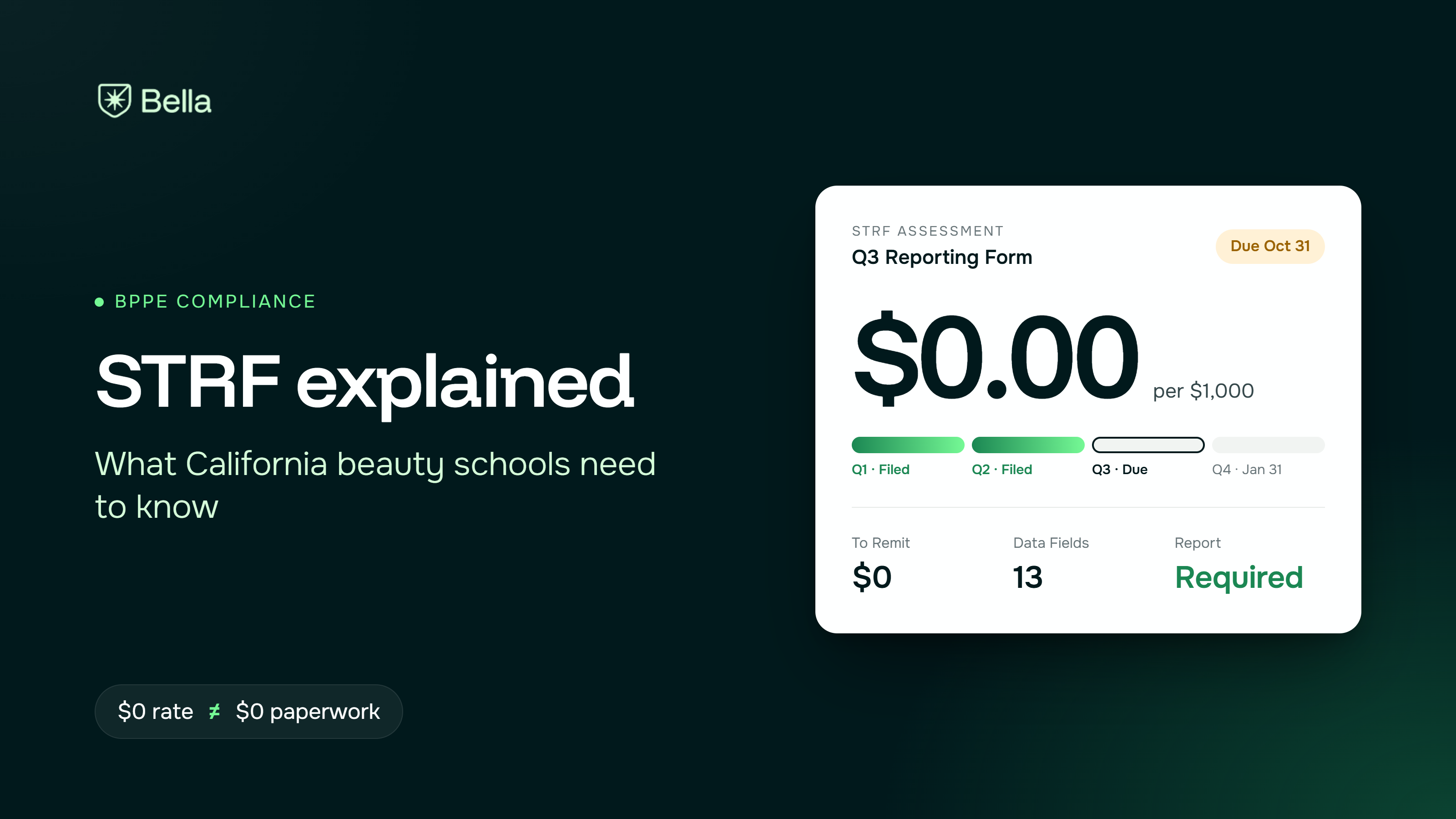
A statement that the student has received the school catalog and the School Performance Fact Sheet for their program before signing. The STRF disclosure language is required under 5 CCR §76215. Even with the current $0.00 assessment rate, this disclosure must appear in the agreement.
Signature and Initials Requirements Beyond the content requirements, BPPE requires specific signatures and initials that many schools get wrong. An authorized employee must sign the agreement. This is not any staff member who happens to be working the front desk. The signer must be formally designated by the school as authorized to execute enrollment agreements. BPPE has cited schools where the person who signed was not on any authorization list and where the school could not produce documentation showing who was authorized to sign. Keep a written record of which employees are authorized to sign enrollment agreements. Update it whenever someone is added or removed. If an inspector asks who signed a particular agreement and whether that person was authorized, you need a clear, documented answer. The student must sign the agreement before the enrollment start date. This is the timing requirement that trips up the most schools. In the 2025 citation data, multiple schools were cited because students signed their agreements after they had already started class. The enrollment conversation happened, the student started attending, and the paperwork trailed behind by days or weeks. BPPE treats this as a compliance failure regardless of intent. Under CEC §94912, the student must initial specific sections of the agreement. These initials confirm that the student received and reviewed the SPFS, understands the cancellation policy, and acknowledges the total charges. Missing initials are cited as a distinct violation, separate from missing signatures. Inspectors check for them specifically.
The SPFS Attachment Requirement The School Performance Fact Sheet for the student's program must be provided before the enrollment agreement is signed. Best practice is to attach it directly to the agreement or include a signed acknowledgment page confirming the student received it.
Schools that provide the SPFS separately (such as by handing it to the student during a tour) but do not document that it was provided before the agreement was signed are vulnerable. If the inspector cannot verify the timing, the enrollment agreement is deficient.
Where Schools Fail Most Often Based on the BPPE citation data from July through December 2025, the most common enrollment agreement failures at beauty and barber schools were: Missing authorized employee signature. Either no staff member signed, or the signer was not formally authorized. Student's signature dated after the enrollment start date. The student began class before the agreement was fully executed. Missing student initials on required disclosure sections. The initial fields were blank or incomplete. Outdated agreement templates. The form did not include all currently required disclosures, itemized charges were incomplete, or the STRF language reflected a previous assessment rate. SPFS not attached or referenced. The fact sheet was not included with the agreement, and no acknowledgment documented that the student received it beforehand. Partially completed agreements. Required fields left blank, sections skipped, or forms that were started at enrollment and never finished.
How to Build a Compliant Enrollment Process Treat the enrollment agreement as a compliance gate. No student moves from enrollment to instruction until the agreement is fully executed: every field completed, authorized employee signature in place, student signature dated before the enrollment start date, all initials present, SPFS attached. Assign a second person to review each completed agreement before the student starts class. The person who conducted the enrollment conversation should not be the same person who verifies the document. A second pair of eyes catches blanks, missing initials, and dating errors.
Review your agreement template at least once per year and whenever regulations change. Compare it line by line against the current text of CEC §94902, §94912, and 5 CCR §76215. If your template is outdated, every agreement signed on that form carries the same compliance gap. Keep a version log. Note when the template was last reviewed, what changes were made, and when the updated version went into use. If an inspector reviews files spanning multiple years, you can show which template was current when each student enrolled. Run a monthly spot-check. Pull three student files and review the enrollment agreement for completeness: signatures, dates, initials, SPFS attachment, itemized charges, and STRF disclosure. Fifteen minutes per month prevents the kind of drift that produces five deficient files out of nine during an inspection.
Frequently asked questions ordered by popularity. Remember that if the visitor has not committed to the call to action, they may still have questions (doubts) that can be answered.
Not at all. We’ll move your data and guide your team. You’ll be ready to go in days, not weeks.
Yes. Bella is built for vocational schools and stays updated with state and federal rules.
Bella is made to be simple. If you can check email, you can use it. And we’re here to help whenever you need.
It helps spot missing info, flags risks early, and reminds you of what’s due—without you having to dig.
Yes. Pricing scales with your size, and most schools save time and money within the first month.
Absolutely. Bella uses encrypted, secure hosting and is fully FERPA compliant.
Tips, checklists, and insights for school owners and admins, written in plain language, not tech speak.