Between July and December 2025, California’s Bureau for Private Postsecondary Education (BPPE) issued 47 citations to 36 barber and beauty schools, with total fines above $290,000 and an average of $6,305 per citation. That sounds like a crackdown. It isn’t one. Nearly every violation traces back to missing paperwork, incomplete student files, or records staff couldn’t produce on request. These are administrative gaps, not legal gray areas, and they keep growing until an inspector walks in and starts pulling files.
This guide is for owners, directors, admissions staff, and compliance staff at California cosmetology, esthetics, and barber schools who want to know what BPPE actually cites. If you need the full list of records inspectors request, go to our BPPE inspection checklist.
Five categories account for the violations in our dataset.
Student records (54). In almost every case, a document was missing: a high school diploma not on file, an enrollment agreement never signed, a file opened at intake and never finished. In several inspections every file reviewed had the same gap. At one school, not one of nine files was complete.
SPFS data (20). These schools published a School Performance Fact Sheet (SPFS) with graduation, exam pass, and placement rates, but couldn’t produce the student-level records behind those numbers. Placement data is part of this. Under 5 CCR § 74112(m), schools must keep employer names and verification for every graduate counted as placed. In one citation, the school director acknowledged having no system to maintain SPFS data at all.
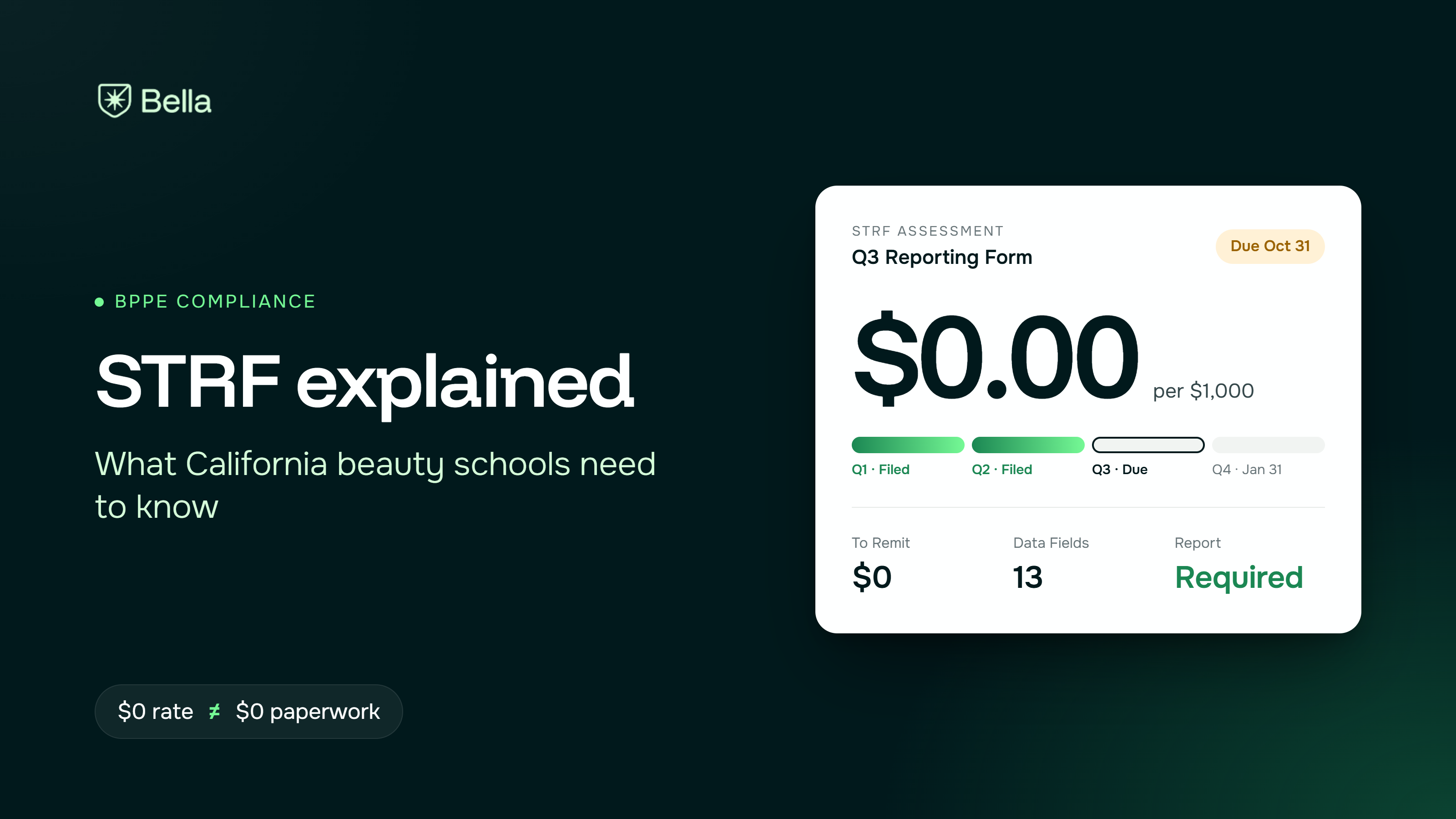
Section 76140 records (10). Section 76140 requires per-student records that back up the Student Tuition Recovery Fund (STRF) quarterly reports, kept in electronic form. The schools cited here couldn’t produce those records.
STRF non-compliance (5) usually meant missing assessments or missing disclosure forms.
Enrollment agreements (5) ranged from missing signatures to students who signed after their start date. BPPE treats a late signature as a failure even if the agreement was completed later.
BPPE conducts both announced and unannounced inspections, and both appear often in the 2025 data. The format is the same either way.
These figures are our arithmetic on the dataset, not BPPE-published averages.
Nearly every violation is an operational failure, not a legal one. Schools aren’t being fined for bad decisions. They’re being fined because the basic systems that would catch gaps were never built.
The point most explainers skip: schools with several violations from one inspection almost always had one root cause. A school cited for missing diplomas was also cited for incomplete enrollment agreements and unsupported SPFS data. Those look like three problems. They are really one: no standard intake and record-keeping process.
That is frustrating, because the fines feel out of proportion to the underlying issue. It’s also encouraging, because the fixes are within your control and don’t require legal expertise, expensive software, or outside consultants.
Compliance isn’t about knowing the regulations. Every school in the dataset knew the rules. It’s about proving you follow them within 15 minutes of an unannounced visit.
Make the student file a gate. Before a student starts class, the file needs proof of high school completion or equivalency (a diploma, GED, or ability-to-benefit results), a fully executed and correctly dated enrollment agreement with all required student initials, the STRF disclosures, and a copy of the SPFS. If anything is missing, the student doesn’t start. This one change prevents the most-cited category.
Track SPFS data all year. Record enrollment counts, completion dates, first-attempt licensing exam results, and placement outcomes per student as they happen. Collect graduate employment details within a few months of graduation, because graduates quickly become unreachable.
Make sure records don’t depend on one person. At least two staff members should know where every file is stored and be able to produce records during all operating hours.
Each of these categories has its own guide:
Start with whichever gap feels most urgent and work outward.
Bella is an AI school management system for beauty and barber schools. During digital enrollment, students submit their details and documents from their phone, and everything lands in their student profile. Any authorized staff member can then produce the file during an inspection, without depending on one person. Bella holds the documents. Your school still decides that a student doesn’t start until the file is complete.
The 2025 citations show that BPPE is finding schools that document poorly, not schools that teach poorly. Close the intake gap, track SPFS data all year, and make sure two people can find every file. Run the nine-file drill this month.
If you want every student file complete at enrollment and producible in minutes, book a Bella demo.
Student records and file maintenance are the most-cited category. They made up 54 of 94 violations at California barber and beauty schools from July to December 2025, according to Bella’s analysis of BPPE citations. SPFS data violations came second with 20.
BPPE fines start at $1,001 per Class B violation and $2,501 per Class A violation, and violations from one inspection stack. In the second half of 2025, the average citation to a California barber or beauty school cost $6,305.
Yes. Under 5 CCR § 71930, records must be immediately available during a BPPE inspection, and failing to produce them is a citation separate from anything wrong inside the files. Several schools were cited for this in 2025 before any records were reviewed.
Yes. BPPE conducts both announced and unannounced inspections of California private postsecondary schools, and both types appear in 2025 citation data. The inspection follows the same format either way, so schools should be ready to produce records on any operating day.
Frequently asked questions ordered by popularity. Remember that if the visitor has not committed to the call to action, they may still have questions (doubts) that can be answered.
Not at all. We’ll move your data and guide your team. You’ll be ready to go in days, not weeks.
Yes. Bella is built for vocational schools and stays updated with state and federal rules.
Bella is made to be simple. If you can check email, you can use it. And we’re here to help whenever you need.
It helps spot missing info, flags risks early, and reminds you of what’s due—without you having to dig.
Yes. Pricing scales with your size, and most schools save time and money within the first month.
Absolutely. Bella uses encrypted, secure hosting and is fully FERPA compliant.
Tips, checklists, and insights for school owners and admins, written in plain language, not tech speak.